桂
| ||||||||
Translingual
Han character
| Stroke order | |||
|---|---|---|---|
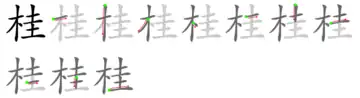 | |||
桂 (Kangxi radical 75, 木+6, 10 strokes, cangjie input 木土土 (DGG), four-corner 44914, composition ⿰木圭)
References
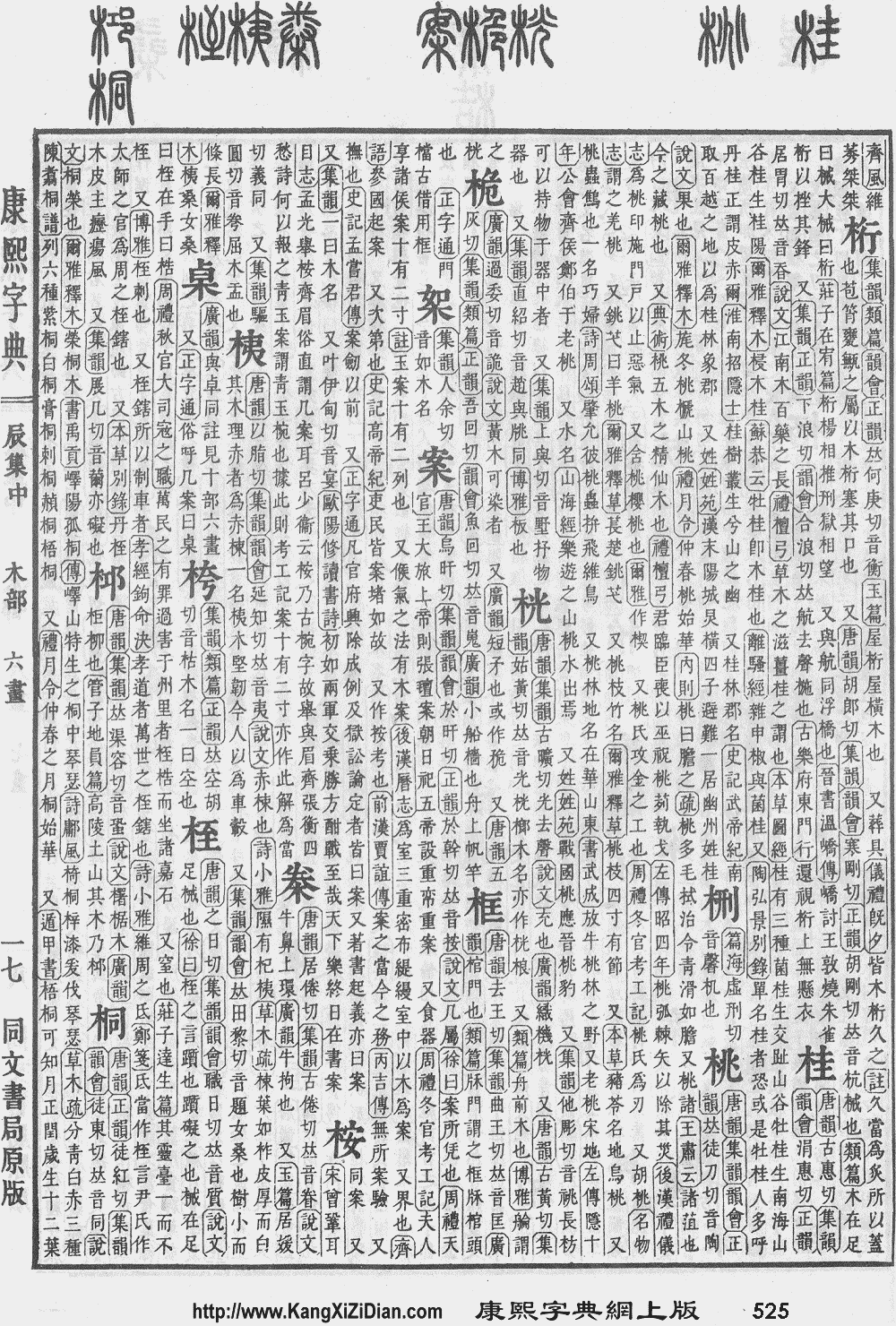
- Kangxi Dictionary: page 525, character 2
- Dai Kanwa Jiten: character 14755
- Dae Jaweon: page 913, character 5
- Hanyu Da Zidian (first edition): volume 2, page 1193, character 5
- Unihan data for U+6842
Chinese
| simp. and trad. |
桂 | |
|---|---|---|
Glyph origin
| Old Chinese | |
|---|---|
| 街 | *kreː, *kreː |
| 鞋 | *ɡreː, *ɡreː, *ɡreː |
| 娾 | *ŋreː, *ŋreːʔ |
| 佳 | *kreː |
| 鮭 | *ɡreː, *kʷeː, *kʰʷeː |
| 涯 | *ŋreː, *ŋre |
| 崖 | *ŋreː, *ŋre |
| 啀 | *ŋreː |
| 厓 | *ŋreː |
| 捱 | *ŋreː |
| 睚 | *ŋreːs |
| 娃 | *qreː |
| 洼 | *qreː, *qʷraː, *kʷeː |
| 哇 | *qreː, *qʷraː |
| 胿 | *ɡeː, *kʷeː |
| 溎 | *qeːns |
| 觟 | *ɡʷraːʔ |
| 黊 | *ɡʷraːʔ, *ɡʷreːs, *ɡʷeː |
| 蘳 | *ɡʷraːʔ, *qʰʷe |
| 蛙 | *qʷraː, *qʷreː |
| 窪 | *qʷraː |
| 卦 | *kʷreːs |
| 挂 | *kʷreːs |
| 掛 | *kʷreːs |
| 詿 | *kʷreːs, *ɡʷreːs |
| 罣 | *kʷreːs, *ɡʷreːs, *kʷeːs |
| 絓 | *kʰʷreː, *ɡʷreːs |
| 鼃 | *ɢʷreː, *qʷreː |
| 圭 | *kʷeː |
| 珪 | *kʷeː |
| 邽 | *kʷeː |
| 閨 | *kʷeː |
| 袿 | *kʷeː |
| 窐 | *kʷeː, *ɡʷeː |
| 茥 | *kʷeː, *kʰʷeː |
| 桂 | *kʷeːs |
| 筀 | *kʷeːs |
| 奎 | *kʰʷeː |
| 刲 | *kʰʷeː |
| 蝰 | *kʰʷeː |
| 楏 | *kʰʷeː |
| 睳 | *qʰʷeː |
| 畦 | *ɡʷeː |
| 眭 | *ɡʷeː, *sqʰʷe, *qʰʷe, *qʰʷi |
| 烓 | *qʷeː, *kʰʷeːŋʔ |
| 跬 | *kʰʷeʔ |
| 恚 | *qʷes |
| 硅 | *qʰʷreɡ |
Phono-semantic compound (形聲/形声, OC *kʷeːs) : semantic 木 + phonetic 圭 (OC *kʷeː).
Pronunciation
Definitions
桂
- osmanthus; sweet osmanthus
- cassia; Chinese cinnamon
- true cinnamon; Saigon cinnamon; Indonesian cinnamon
- laurel; bay laurel
- of or relating to Guilin, Guangxi, or the region of the Gui River
- a surname
Compounds
- 丹桂 (dānguì)
- 吳剛伐桂/吴刚伐桂
- 折桂 (zhéguì)
- 折桂攀蟾
- 攀仙桂
- 攀桂
- 攀桂客
- 攀蟾折桂
- 月中折桂
- 月中桂
- 月桂 (yuèguì)
- 月桂冠 (yuèguìguān)
- 月桂樹/月桂树 (yuèguìshù)
- 木桂
- 杭桂 (Hángguì)
- 桂冠 (guìguān)
- 桂冠詩人/桂冠诗人
- 桂劇/桂剧 (guìjù)
- 桂圓/桂圆 (guìyuán)
- 桂圓肉/桂圆肉 (guìyuánròu)
- 桂堂
- 桂子
- 桂子蘭孫/桂子兰孙
- 桂子飄香/桂子飘香
- 桂宮/桂宫
- 桂宮柏寢/桂宫柏寝
- 桂山 (Guìshān)
- 桂戲/桂戏
- 桂旗
- 桂月 (guìyuè)
- 桂林 (Guìlín)
- 桂枝 (guìzhī)
- 桂林一枝
- 桂棟/桂栋
- 桂棹
- 桂樹/桂树
- 桂水
- 桂江
- 桂海
- 桂漿/桂浆
- 桂父
- 桂王
- 桂皮 (guìpí)
- 桂皮酸
- 桂秋
- 桂窟
- 桂竹 (guìzhú)
- 桂竹香
- 桂籍
- 桂舟
- 桂花 (guìhuā)
- 桂花糕
- 桂花茶 (guìhuā chá)
- 桂花酒 (guìhuājiǔ)
- 桂花醬/桂花酱
- 桂蠹
- 桂輪/桂轮
- 桂酒
- 桂陽/桂阳 (Guìyáng)
- 桂馥蘭芳/桂馥兰芳
- 桂魄 (guìpò)
- 桂魚/桂鱼
- 炊桂
- 爨桂炊玉
- 米珠薪桂
- 肉桂 (ròuguì)
- 菌桂
- 薑桂/姜桂
- 薪桂米珠
- 薑桂老辣/姜桂老辣 (jiāngguìlǎolà)
- 藏桂 (Cángguì)
- 蘭桂/兰桂
- 蘭桂騰芳/兰桂腾芳
- 蘭桂齊芳/兰桂齐芳
- 蘭薰桂馥/兰薰桂馥
- 蟾宮折桂/蟾宫折桂 (chángōngzhéguì)
- 蟾桂
- 銀桂/银桂
- 食玉炊桂
Etymology 2
| For pronunciation and definitions of 桂 – see 鱖 (“mandarin fish; Chinese perch”). (This character, 桂, is the second-round simplified form of 鱖). |
Notes:
|
Japanese
Readings
Compounds
- 丹桂 (tankei, “golden osmanthus (Osmanthus fragrans)”)
- 桂子 (Keiko): a female given name
- 桂飴 (katsurāme): a type of sweet traditionally sold in villages in the mountains around Kyōto Prefecture
- 桂鮎 (katsurāyu): ayu (sweetfish) caught in the Katsura River in Kyōto
- 桂庵 (keian): a mediary in an arranged marriage or in a lawsuit; a hiring placement specialist
- 桂園 (Keien): pseudonym for 香川景樹 (Kagawa Kageki), a poet during the late Edo Period
- 桂園一枝 (Keien Isshi): a private anthology of poetry printed towards the end of the Edo Period
- 桂園派 (Keienha): a style of 和歌 (waka) poetry, founded by 香川景樹 (Kagawa Kageki)
- 桂科 (katsuraka): the Cercidiphyllaceae family, containing only the Cercidiphyllum genus, containing only the two species Cercidiphyllum japonicum and Cercidiphyllum magnificum, both commonly called 桂 (katsura)
- 桂花 (keika), 桂華 (keika): (metaphor) the moon, from a Chinese legend of trees growing on the moon
- 桂冠 (keikan): a laurel wreath
- 桂冠詩人 (keikan shijin): a poet laureate
- 桂巻 (katsura maki): a style of women's head wrapping popular during the Muromachi Period, using a long piece of cloth tied in front above the forehead
- 桂宮 (Katsura-no-miya): one of the four 親王家 (shinnōke, “branches of the Imperial Family of Japan which were eligible to succeed to the Chrysanthemum Throne in the event that the main line should die out”)
- 桂宮院 (Keikyūin), 桂宮院 (Keigūin): the inner temple building at the Hōryūji Temple in Kyoto
- 桂月 (keigetsu): alternative word for 月 (tsuki, “the moon”); the eighth lunar month
- 桂湖村 (Katsura Koson): a Japanese author, lived 1868-1934
- 桂江 (Keikō): a river in the Chūgoku region of Japan
- 桂三木助 (Katsura Mikisuke): a traditional Japanese comedian (落語 (rakugo) performer); the first by this name lived 1894-1943, the second lived 1902-1961
- 桂枝 (keishi): a branch from a cassia, katsura, laurel, or cinnamon tree; a branch from the legendary tree that grows on the moon
- 桂芝 (keishi): alternative word for 万年茸 (mannentake), a type of mushroom
- 桂樹 (keiju): common name for various trees in family Lauraceae, particularly the cinnamon or cassia trees; a legendary tree growing on the moon; alternative for 浜枇杷 (hamabiwa, “a type of tree in the genus Litsea, related to the laurel”)
- 桂秋 (keishū): alternative word for 秋 (aki, “autumn”)
- 桂春団治 (Katsura Harudanji): stage name for 川田藤吉 (Kawada Fujiyoshi), a 落語 (rakugo, “traditional Japanese comedy”) performer in Ōsaka, lived 1881-1937
- 桂女 (katsurame): a type of 巫女 (miko, “shrine maiden”); a woman selling of katsura ayu and katsura ame in areas around old Kyōto; a prostitute from the village of Katsura near Kyōto; a noblewoman's bridesmaid in ancient Japan
- 桂小五郎 (Katsura Kogorō): former name of 木戸孝允 (Kido Takayoshi), an important politician in the late Edo Period and early Meiji Period
- 桂昌院 (Keishōin): concubine of 徳川家光 (Tokugawa Iemitsu), the third Tokugawa shōgun
- 桂心 (keishin): cinnamon or cassia bark, as used in cooking; Cinnamomum tenuifolium, Japanese cinnamon; a type of mochi confection coated in cinnamon powder
- 桂仙花 (keisenka): alternative word for 翁草 (okinagusa), Pulsatilla cernua, a type of low-growing anemone
Etymology 1
| Kanji in this term |
|---|
| 桂 |
| かつら Jinmeiyō |
| kun’yomi |
From Old Japanese. Originally a compound of 香 (ka, “fragrance, good smell”) + 出 (zu, “to come out, to put something out”) + ら (ra, nominalizing suffix): "that which puts out a good smell", from the way the wood smells good.
Alternative forms
- 楓 (uncommon)
Noun
桂 • (katsura)
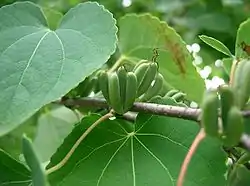
- the katsura tree, Cercidiphyllum japonicum, also called the Japanese Judas tree
- less commonly, the smaller Cercidiphyllum magnificum tree, more specifically called the 広葉桂 or ヒロハカツラ (hiroha katsura, “broadleaf katsura”).
- a tree on the moon, from a Chinese legend that the phases of the moon were caused by Lauraceae trees budding, blossoming, then dropping their flowers and leaves again as if in accelerated seasons
- julienned raw daikon, used as a garnish for sashimi
- alternative word for 肉桂 (nikkei, “the cinnamon or cassia tree”) or 桂皮 (keihi, “cinnamon or cassia bark”)
Derived terms
- 桂男 (katsura otoko): the katsura man, a character in the Chinese legend who lives on the moon
Proper noun
桂 • (Katsura)
- a male given name
- a surname
- the west bank of the Katsura River in Kyōto
Etymology 2
| Kanji in this term |
|---|
| 桂 |
| めかつら Jinmeiyō |
| kun’yomi |
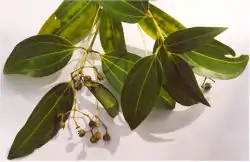
From Old Japanese. Alternative spelling for 女桂 (mekatsura, “female katsura”), an archaic name for the cinnamon tree. Compare 男桂 (okatsura, “male katsura: the katsura tree”). Appears with this reading in the 和名類聚抄 (Wamyō Ruijushō), a Japanese dictionary of Chinese characters completed in 938.
Alternative forms
- 女桂 (mekatsura)
Pronunciation
- IPA(key): [me̞ka̠t͡sɨᵝɾa̠]
Synonyms
- 肉桂 (nikkei)
Noun
桂 • (kei)
Etymology 4
| Kanji in this term |
|---|
| 桂 |
| けい Jinmeiyō |
| on’yomi |
From a Chinese legend that the phases of the moon were caused by kei trees, which would bud, blossom, then drop their flowers and leaves again as if in accelerated seasons.
Pronunciation
- IPA(key): [ke̞ː]
Etymology 5
| Kanji in this term |
|---|
| 桂 |
| けい Jinmeiyō |
| on’yomi |
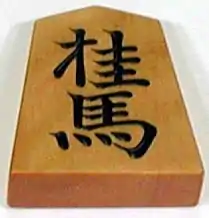
Abbreviation of 桂馬 (keima), the knight in 将棋 (shōgi, “Japanese chess”).
Pronunciation
Synonyms
- 桂馬 (keima)