棗
| ||||||||
Translingual
Han character
棗 (Kangxi radical 75, 木+8, 12 strokes, cangjie input 木月木月 (DBDB) or X木月木月 (XDBDB), four-corner 50902, composition ⿱朿朿)
Derived characters
- 𪦡, 𭫼, 𫓇, 𤒗, 𫼄, 𮐿
Descendants
References
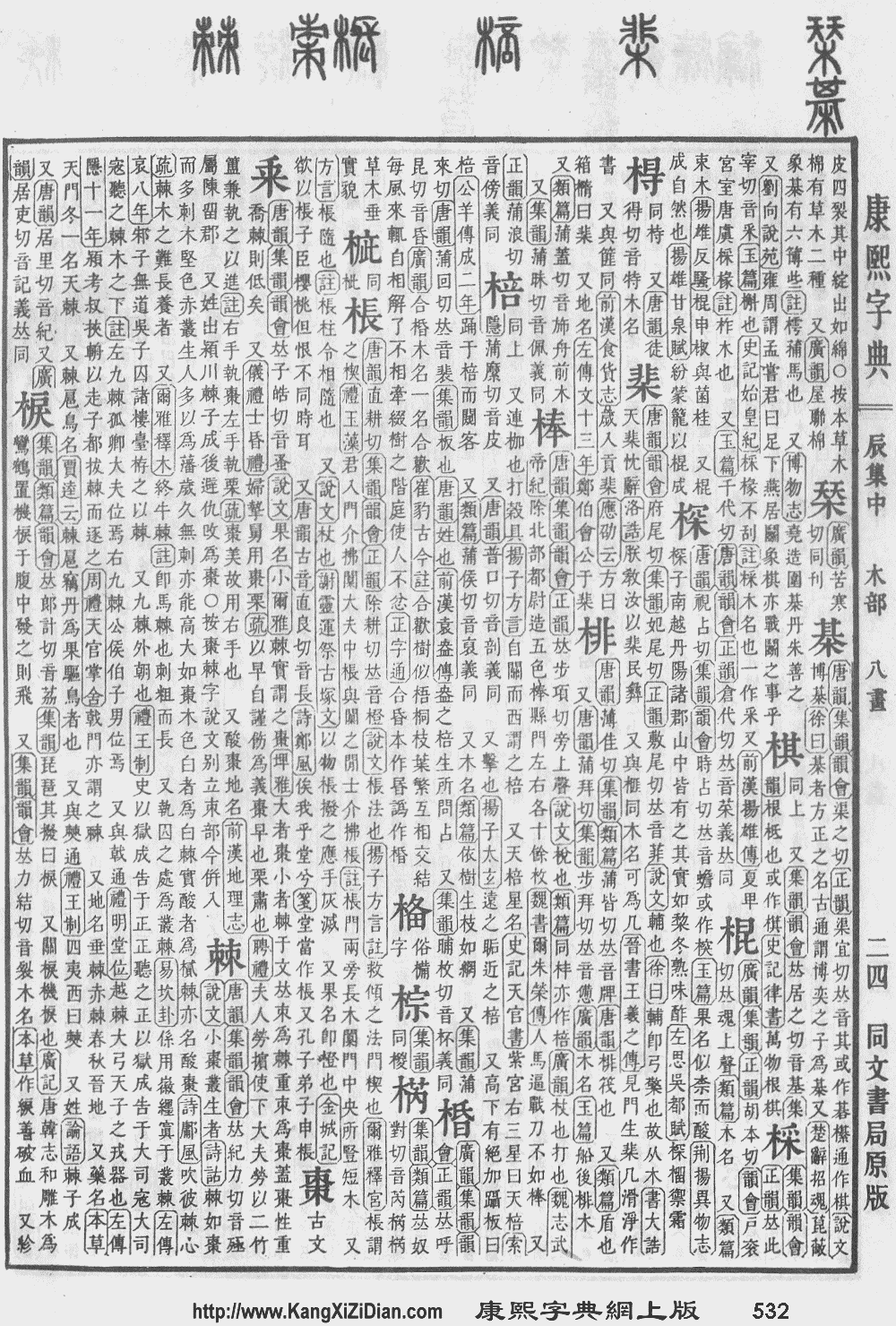
- Kangxi Dictionary: page 532, character 18
- Dai Kanwa Jiten: character 14937
- Dae Jaweon: page 920, character 24
- Hanyu Da Zidian (first edition): volume 2, page 1228, character 1
- Unihan data for U+68D7
Chinese
Lua error in Module:utilities at line 142: attempt to perform arithmetic on local 'h' (a nil value)
Glyph origin
| Historical forms of the character 棗 | ||
|---|---|---|
| Western Zhou | Shuowen Jiezi (compiled in Han) | Liushutong (compiled in Ming) |
| Bronze inscriptions | Small seal script | Transcribed ancient scripts |
 |
 |
 |
Ideogrammic compound (會意/会意) : Duplication of 朿 (“thorn”).
Etymology
(This etymology is missing or incomplete. Please add to it, or discuss it at the Etymology scriptorium.)
Pronunciation
Synonyms
- (jujube):
Lua error in Module:utilities at line 142: attempt to perform arithmetic on local 'h' (a nil value)
Compounds
- 三更棗/三更枣
- 乳棗/乳枣
- 交梨火棗/交梨火枣
- 京棗/京枣
- 仙人棗/仙人枣
- 仙棗/仙枣
- 仲思棗/仲思枣
- 千年棗/千年枣
- 吃黑棗/吃黑枣
- 吃黑棗兒/吃黑枣儿
- 咒棗/咒枣
- 嗜棗/嗜枣
- 嘎嘎棗兒/嘎嘎枣儿
- 囫圇吞棗/囫囵吞枣 (húlúntūnzǎo)
- 大棗/大枣 (dàzǎo)
- 嫁棗/嫁枣
- 安期棗/安期枣
- 巨棗/巨枣
- 弱枝棗/弱枝枣
- 拔葵啖棗/拔葵啖枣
- 推梨讓棗/推梨让枣
- 撲棗/扑枣
- 昌歜羊棗/昌歜羊枣
- 枵棗/枵枣
- 梬棗/梬枣
- 梨棗/梨枣
- 棗下/枣下
- 棗仁/枣仁
- 棗兒紅/枣儿红
- 棗呢/枣呢
- 棗圃/枣圃
- 棗圈/枣圈
- 棗園/枣园
- 棗塔/枣塔
- 棗子/枣子 (zǎozi)
- 棗實/枣实
- 棗店/枣店 (Zǎodiàn)
- 棗徑/枣径
- 棗心筆/枣心笔
- 棗昏/枣昏
- 棗木/枣木
- 棗本/枣本
- 棗林/枣林
- 棗核/枣核
- 棗栗/枣栗
- 棗核筆/枣核笔
- 棗核臉/枣核脸
- 棗核釘/枣核钉
- 棗梨/枣梨
- 棘棗/棘枣
- 棗椰/枣椰
- 棗椰子/枣椰子 (zǎoyēzi)
- 棗槊/枣槊
- 棗榛/枣榛
- 棗樹/枣树 (zǎoshù)
- 棗油/枣油
- 棗泥/枣泥
- 棗泥酥/枣泥酥
- 棗瓜/枣瓜
- 棗穰金/枣穰金
- 棗節杖/枣节杖
- 棗糕/枣糕
- 棗糒/枣糒
- 棗糗/枣糗
- 棗紅/枣红 (zǎohóng)
- 棗紅色/枣红色
- 棗脯/枣脯
- 棗脩/枣脩
- 棗膏昏鈍/枣膏昏钝
- 棗花/枣花
- 棗莊/枣庄 (Zǎozhuāng)
- 棗華/枣华
- 棗菜/枣菜
- 棗蔬/枣蔬
- 棗行/枣行
- 棗貓/枣猫
- 棗逕/枣迳
- 棗陽/枣阳 (Zǎoyáng)
- 棗騮/枣骝
- 楓天棗地/枫天枣地
- 椰棗/椰枣 (yēzǎo)
- 㮕棗/㮕枣
- 樂毅棗/乐毅枣
- 樂氏棗/乐氏枣
- 橪棗/橪枣
- 檽棗/檽枣
- 沙棗/沙枣 (shāzǎo)
- 波斯棗/波斯枣
- 海棗/海枣 (hǎizǎo)
- 渾掄吞棗/浑抡吞枣
- 渾淪吞棗/浑沦吞枣
- 火棗/火枣
- 災梨禍棗/灾梨祸枣
- 焦棗/焦枣
- 牙棗/牙枣
- 猴棗/猴枣 (hóuzǎo)
- 番棗/番枣
- 白棗/白枣
- 禍棗災梨/祸枣灾梨
- 紅棗/红枣 (hóngzǎo)
- 纓絡棗/缨络枣
- 羊棗/羊枣
- 羊棗昌歜/羊枣昌歜
- 羊矢棗/羊矢枣
- 肉棗/肉枣
- 肉棗兒/肉枣儿
- 脯棗/脯枣
- 膠棗/胶枣
- 良棗/良枣
- 蜜棗/蜜枣 (mìzǎo)
- 讓棗推梨/让枣推梨
- 軟棗/软枣
- 酸棗/酸枣 (suānzǎo)
- 酸棗子/酸枣子
- 重棗/重枣 (zhòngzǎo)
- 金棗/金枣
- 金絲棗/金丝枣
- 鋟棗/锓枣
- 靈棗/灵枣
- 面如重棗/面如重枣 (miàn rú zhòngzǎo)
- 食棗約/食枣约
- 馬棗/马枣
- 鬢棗/鬓枣
- 鶻崙吞棗/鹘仑吞枣
- 鹽官棗/盐官枣
- 黑棗/黑枣 (hēizǎo)
- 龍棗/龙枣
Descendants
- → Vietnamese: táo (Lua error in Module:utilities at line 142: attempt to perform arithmetic on local 'h' (a nil value))
References
- “棗”, in 漢語多功能字庫 (Multi-function Chinese Character Database), 香港中文大學 (the Chinese University of Hong Kong), 2014–
Japanese
Readings
Lua error in Module:utilities at line 142: attempt to perform arithmetic on local 'h' (a nil value)
Etymology
| Kanji in this term |
|---|
| 棗 |
| なつめ Hyōgaiji |
| kun’yomi |
From Old Japanese. Originally a compound of 夏 (natsu, “summer”) + 芽 (me, “bud, sprout”).[1]
Noun
棗 • (natsume)
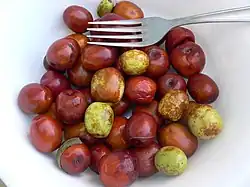
- the jujube or Chinese date, Ziziphus jujuba
- Hypernym: 黒梅擬 (kuroumemodoki)
- a dye made from dried jujube fruits
- a small tea caddy used in the tea ceremony
Derived terms
- 棗貝 (natsumegai)
- 棗形手水鉢 (natsume-gata chōzubachi)
- 棗玉 (Natsumedama)
- 棗椰子 (natsume yashi, “date palm”, Phoenix dactylifera)
- 唐棗 (kara-natsume)
- 小棗 (konatsume)
- 核太棗, 酸棗 (sanebuto natsume)
- 浜棗 (hama natsume)
- 平棗 (hira natsume)
See also
- 五果, 五菓 (goka, “five fruits”): 桃 (momo, “peach”), 李 (sumomo, “Japanese plum”), 杏 (anzu, “apricot”), Lua error in Module:utilities at line 142: attempt to perform arithmetic on local 'h' (a nil value), 栗 (kuri, “Japanese chestnut”)
Korean
Etymology
(This etymology is missing or incomplete. Please add to it, or discuss it at the Etymology scriptorium. Particularly: “Middle Korean readings, if any”)
Pronunciation
- (SK Standard/Seoul) IPA(key): [t͡ɕo̞]
- Phonetic hangul: [조]
Hanja
Wikisource 棗 • (jo) (hangeul 조, revised jo, McCune–Reischauer cho, Yale co)
- This term needs a translation to English. Please help out and add a translation, then remove the text
{{rfdef}}.
Compounds
- 조율 (棗栗, joyul)