hyena
English
Etymology
From Middle English hiena, variant of hyene, from Old French hiene, from Lua error in Module:utilities at line 142: attempt to perform arithmetic on local 'h' (a nil value), from Latin hyaena, from Ancient Greek ὕαινα (húaina). Displaced native Old English nihtgenġe (literally “night walker”).
Pronunciation
- enPR: hī-ēʹnə, IPA(key): /haɪˈiːnə/
Audio (US) (file)
Noun
Lua error in Module:utilities at line 142: attempt to perform arithmetic on local 'h' (a nil value)
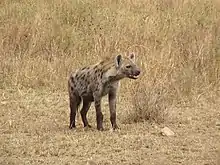
- Any of the medium-sized to large feliform carnivores of the subfamily Hyaenidae, native to Africa and Asia and noted for the sound similar to laughter which they can make if excited.
- 2003, Anne Engh, Kay E. Holekamp, “Case Study 5A: Maternal Rank "Inheritance" in the Spotted Hyena”, in Frans B. M. De Waal, Peter L Tyack, editors, Animal Social Complexity: Intelligence, Culture, and Individualized Societies, page 149:
- Hyena biologists often think of spotted hyenas (Crocuta crocuta) as baboons with big teeth and relatively small brains.
- (Sub-Saharan Africa) A man that performs ritualized sex acts with recently widowed women and menarchal girls.
- see Citations:hyena
Usage notes
The hyena family, Hyaenidae, also includes the smaller insectivorous aardwolf, the sole survivor of a lineage regarded as more dog-like.
Derived terms
Translations
|
See also
Czech
Pronunciation
- IPA(key): [ˈɦɪjɛna]
Noun
hyena f
- Lua error in Module:utilities at line 142: attempt to perform arithmetic on local 'h' (a nil value) (large carnivore)
Declension
Lua error in Module:utilities at line 142: attempt to perform arithmetic on local 'h' (a nil value)
Related terms
- hyenismus
- hyení
Dutch
Etymology
Borrowed from Latin hyaena, from Ancient Greek ὕαινα (húaina).
Pronunciation
- IPA(key): /ɦiˈjeːnaː/
audio (file) - Hyphenation: hy‧e‧na
Derived terms
Swedish
Declension
Lua error: attempt to perform arithmetic on local 'h' (a nil value)