shale
English
Etymology
From Middle English schale (“shell, husk; scale”), from Old English sċealu (“shell, husk, pod”), from Proto-Germanic *skalō (compare West Frisian skaal (“dish”), Dutch schaal (“shell”), schalie (“shale”), German Schale (“husk, pod”)), from Proto-Indo-European *(s)kelH- (“to split, cut”) (compare Lithuanian skalà (“splinter”), Old Church Slavonic скала (skala, “rock, stone”), Polish skała (“rock”), Albanian halë (“fish bone, splinter”), Sanskrit कल (kalá, “small part”)), from *(s)kel- (“to split, cleave”) (compare Hittite [script needed] (iškalla, “to tear apart, slit open”), Lithuanian skélti (“to split”), Ancient Greek σκάλλω (skállō, “to hoe, harrow”)). Doublet of scale. See also shell.
Pronunciation
- IPA(key): /ʃeɪl/
- Rhymes: -eɪl
Audio (Southern England) (file)
Noun
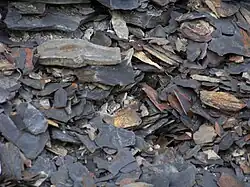
shale (countable and uncountable, plural shales)
- A shell or husk; a cod or pod.
- c. 1610s, Homer (attributed), translated by George Chapman, The Crowne of all Homers Workes: Batrachomyomachia, or the Battaile of Frogs and Mise […], published 1624:
- the green shales of a bean
- (geology) A fine-grained sedimentary rock of a thin, laminated, and often friable, structure.
Usage notes
Before the mid-19th century, the terms Lua error in Module:utilities at line 142: attempt to perform arithmetic on local 'h' (a nil value), slate and schist were not sharply distinguished. Lua error in Module:utilities at line 142: attempt to perform arithmetic on local 'h' (a nil value) that are subject to heat and pressure alter into slate, then schist and finally to gneiss.
Derived terms
Translations
|
Verb
shale (third-person singular simple present shales, present participle shaling, simple past and past participle shaled)
- To take off the shell or coat of.