Helene (satélite)
Helene, também conhecido como Saturno XII ou Dione B,[3] é um satélite natural de Saturno. Foi descoberto por Pierre Laques e Jean Lecacheux em 1980, em observações terrestres feitas no Observatório Pic du Midi, e recebeu a designação provisória S/1980 S 6.[4] Em 1988 foi nomeado oficialmente a partir de Helena de Troia, que foi a neta de Cronos (Saturno) na mitologia grega.[5] Helene é co-orbital com Dione e está localizado em seu ponto de Lagrange L4.
| Helene | |
|---|---|
| Satélite Saturno XII | |
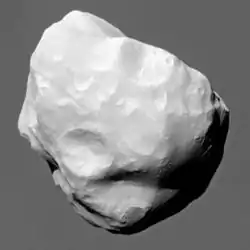 Imagens de Helene obtida pela Cassini-Huygens em 3 de março de 2010. | |
| Características orbitais[1] | |
| Semieixo maior | 151 410 km |
| Excentricidade | 0,0098 |
| Período orbital | 0,694 d |
| Inclinação | 0,351 ° |
| Argumento do periastro | 312,630° |
| Longitude do nó ascendente | 85,244° |
| Características físicas[2] | |
| Diâmetro equatorial | 35,2 ± 0,8 km |
| Densidade média | 0,5 g/cm³ |
| Albedo | 0,6 |
| Magnitude aparente | 18,4 |
Referências
- «Planetary Satellite Mean Orbital Parameters». Jet Propulsion Laboratory. Consultado em 27 de fevereiro de 2011
- «Planetary Satellite Physical Parameters». Jet Propulsion Laboratory. Consultado em 27 de fevereiro de 2011
- IAUC 3872: Satellites of Jupiter and Saturn[ligação inativa], 30 de setembro de 1983)
- IAUC 3496: Satellites of Saturn[ligação inativa] 31 de julho de 1980 (descoberta)
- IAUC 4609: Satellites of Saturn and Uranus[ligação inativa] 8 de junho de 1988 (nomeando a lua)
This article is issued from Wikipedia. The text is licensed under Creative Commons - Attribution - Sharealike. Additional terms may apply for the media files.