Ä
| ||||||||||
Central Franconian
Etymology
Pronunciation
- IPA(key): (short) /ɛ/, (long) /ɛː/
Letter
Ä
- A letter in the German-based alphabet of Central Franconian.
Usage notes
- In the Dutch-based spelling, short /ɛ/ is always represented by E (see there). Long /ɛː/ is represented by ae or è(è).
- Long ä may be doubled to ää in the following cases:
- when it is followed by two or more consonants: Wääch or Wäch;
- when the German cognate has two vowel letters: Stään or Stän (German Stein);
- when the German cognate has a consonant lost or not present in Central Franconian: Stään or Stän (German Stern);
- when the German cognate has a short vowel: ääße or äße (German essen).
- /ɛː/ is always represented by ä, never e.
- /ɛ/ may be represented by e or ä. The latter of these is used when the German cognate has ä or a. It may or may not be used in the following cases:
- when the German cognate has another umlaut letter: Läffel or Leffel (German Löffel);
- when the German cognate has er: Hätz or Hetz (German Herz);
- when there is a related word with a: trämmele or tremmele (because of the variant trammele);
- when there is a special reason to specify that the vowel is /ɛ/, not /e/: bränge or brenge (because German bringen suggests /e/).
- /œy̯/, /øy̯/ may be represented by eu or äu. The latter of these is used when the German cognate has äu or au. It may or may not be used when there is a related word with au: däue or deue (because of related Dau).
Elfdalian
Alternative forms
- ᚯ (Dalecarlian runes)
Estonian
Letter
Ä (upper case, lower case ä)
See also
- Lua error in Module:utilities at line 142: attempt to perform arithmetic on local 'h' (a nil value)
Finnish
Etymology
From Lua error in Module:utilities at line 142: attempt to perform arithmetic on local 'h' (a nil value) and/or its origin, Lua error in Module:utilities at line 142: attempt to perform arithmetic on local 'h' (a nil value), in which the umlaut (two dots) were originally a lowercase e, first placed to the side and later on top of a/A to signify fronting of the vowel via Germanic umlaut. This letter was already used in the earliest known Finnish writings in the 16th century, where it in fraktur (blackletter) still clearly displayed the lowercase e (aͤ). Over time, its usage became more regular as the Finnish spelling did, and the e simplified into two vertical lines and then two dots, as in the other regions where the letter is used.
Letter
Ä (upper case, lower case ä)
Usage notes
Should not be replaced by ae in case of technical restrictions (like in e.g. German), as that may change the meaning.
See also
- Lua error in Module:utilities at line 142: attempt to perform arithmetic on local 'h' (a nil value)
German
Alternative forms
- ä (lowercase)
Etymology
- (letter) From Alemannic Middle High German aͤ, a representation of secondary umlaut [æ]. In Early Modern German, the letter spread to Central German, which did not have a special phoneme for secondary umlaut. Therefore, ä was seen there as a marker of umlaut as such, and was used analogously.
- (sound) Middle High German distinguished up to five stressed e-vowels: [æ], [ɛ], [ɛː], [e], [eː]. Through open-syllable lengthening, mergers, and analogy, this system was not just reduced but entirely altered. 19th-century Standard German generally retained only one short vowel, but distinguished [ɛː] from [eː]. All long ‹ä› were by then usually pronounced [ɛː], while ‹e› was [ɛː] in some words, [eː] in others. The choice between these, however, varied greatly from region to region, and was entirely absent in many Low German areas. Theodor Siebs therefore (consistently but rather arbitrarily) restricted [ɛː] to the spelling ‹ä› in his codification of stage and broadcasting German.
Pronunciation
- IPA(key): /ɛː/, /ˌaː ˈʊmlaʊ̯t/ (letter name)
Audio (file)
- IPA(key): /ɛ/ (short phoneme)
- IPA(key): /ɛː/, [ɛː], [eː] (long phoneme)
- The distinction between long /ɛː/ and /eː/ is maintained in some regions, including Switzerland and most of western Germany. In many other regions the two are merged in normal speech, though speakers may nevertheless distinguish them in individual words and in enunciation.
- Rhymes: -eː (one pronunciation)
- Homophones: E, eh (one pronunciation)
Letter
Lua error in Module:utilities at line 142: attempt to perform arithmetic on local 'h' (a nil value)
Declension
Lua error in Module:utilities at line 142: attempt to perform arithmetic on local 'h' (a nil value)
Kalo Finnish Romani
Letter
Ä (upper case, lower case ä)
See also
- Lua error in Module:utilities at line 142: attempt to perform arithmetic on local 'h' (a nil value)
References
- Kimmo Granqvist (2011), “Aakkoset [Alphabet]”, in Lyhyt Suomen romanikielen kielioppi [Consice grammar of Finnish Romani] (in Finnish), Kotimaisten kielten keskus, →ISBN, →ISSN, retrieved February 6, 2022, pages 1-2
Luxembourgish
Alternative forms
- ä (lowercase)
Pronunciation
- IPA(key): [æ] (short phoneme)
- IPA(key): [ɛː] (long phoneme before /r/, phonemically /eː/)
- IPA(key): [ɛː] (long phoneme elsewhere, phonemically /ɛː/)
Usage notes
- The short vowel [æ] is spelt ä (rather than e) when it occurs as an umlaut in inflections. Otherwise its use is chiefly dependent on the spelling of the German cognate. Ä is used when the German word has one of a, ä, o, ö, thus e.g. Fläsch and Fräsch (German Flasche, Frosch). If no German cognate exists, ä is used when there is a closely related Luxembourgish word with a.
- The long vowel [ɛː] is always spelt ä. In native Luxembourgish words this sound occurs only before r as an allophone of /eː/. Elsewhere it must be interpreted as a distinct phoneme /ɛː/, which is restricted to borrowings.
Romani
Letter
Lua error in Module:utilities at line 142: attempt to perform arithmetic on local 'h' (a nil value)
- (International Standard) Used to represent a dialectal centralized vowel.
See also
- (Latin-script letters) A a, B b, C c, D d, E e, F f, G g, H h, X x, I i, J j, K k, Kh kh, L l, M m, N n, O o, P p, Ph ph, R r, S s, T t, Th th, U u, V v, Z z International Standard: Lua error in Module:utilities at line 142: attempt to perform arithmetic on local 'h' (a nil value). Pan-Vlax: Č č, Čh čh, Dž dž, (Dź dź), Ř ř, Š š, (Ś ś), Ž ž, (Ź ź).
References
- Marcel Courthiade (2009), “DECISION : "THE ROMANI ALPHABET"”, in Melinda Rézműves, editor, Morri angluni rromane ćhibǎqi evroputni lavustik = Első rromani nyelvű európai szótáram : cigány, magyar, angol, francia, spanyol, német, ukrán, román, horvát, szlovák, görög [My First European-Romani Dictionary: Romani, Hungarian, English, French, Spanish, German, Ukrainian, Romanian, Croatian, Slovak, Greek] (in Hungarian; English), Budapest: Fővárosi Onkormányzat Cigány Ház--Romano Kher, →ISBN, page 499
- Yūsuke Sumi (2018), “ä”, in ニューエクスプレス ロマ(ジプシー)語 [New Express Romani (Gypsy)] (in Japanese), Tokyo: Hakusuisha, →ISBN, page 16
Skolt Sami
Pronunciation
- (phoneme) IPA(key): /a/
Letter
Ä (lower case ä)
See also
- Lua error in Module:utilities at line 142: attempt to perform arithmetic on local 'h' (a nil value)
Slovene
Etymology 1
From Lua error in Module:utilities at line 142: attempt to perform arithmetic on local 'h' (a nil value), with its corresponding pronunciation, which is still used by some speakers, however, the majority of speakers have vernacularized the pronunciation to a long close-mid vowel regardless of the initial pronunciation.
Pronunciation
- (phoneme): IPA(key): /éː/, /èː/, [ɛ́ː]
- (letter name, common): IPA(key): /prɛɡlaʃɛ̀ːni àː/, /prɛɡlaʃɛ̀ːni áː/ (preglašeni a)
- (letter name, educated): IPA(key): /ɛ̀ː/, /ɛ́ː/
- Rhymes: -ɛː
- Homophone: e
Letter
Ä (upper case, lower case ä)
- Additional letter in Slovene common mostly in loanwords from German.
Usage notes
It is more common to use the name preglašeni a than to use this name.
Inflection
- Overall more common
Lua error: attempt to perform arithmetic on local 'h' (a nil value)
- More common when with a definite adjective
| Masculine inan., no endings | |||
|---|---|---|---|
| nom. sing. | Lua error in Module:utilities at line 142: attempt to perform arithmetic on local 'h' (a nil value) | ||
| gen. sing. | Lua error in Module:utilities at line 142: attempt to perform arithmetic on local 'h' (a nil value) | ||
| singular | dual | plural | |
| nominative | Lua error in Module:utilities at line 142: attempt to perform arithmetic on local 'h' (a nil value) | Lua error in Module:utilities at line 142: attempt to perform arithmetic on local 'h' (a nil value) | Lua error in Module:utilities at line 142: attempt to perform arithmetic on local 'h' (a nil value) |
| accusative | Lua error in Module:utilities at line 142: attempt to perform arithmetic on local 'h' (a nil value) | Lua error in Module:utilities at line 142: attempt to perform arithmetic on local 'h' (a nil value) | Lua error in Module:utilities at line 142: attempt to perform arithmetic on local 'h' (a nil value) |
| genitive | Lua error in Module:utilities at line 142: attempt to perform arithmetic on local 'h' (a nil value) | Lua error in Module:utilities at line 142: attempt to perform arithmetic on local 'h' (a nil value) | Lua error in Module:utilities at line 142: attempt to perform arithmetic on local 'h' (a nil value) |
| dative | Lua error in Module:utilities at line 142: attempt to perform arithmetic on local 'h' (a nil value) | Lua error in Module:utilities at line 142: attempt to perform arithmetic on local 'h' (a nil value) | Lua error in Module:utilities at line 142: attempt to perform arithmetic on local 'h' (a nil value) |
| locative | Lua error in Module:utilities at line 142: attempt to perform arithmetic on local 'h' (a nil value) | Lua error in Module:utilities at line 142: attempt to perform arithmetic on local 'h' (a nil value) | Lua error in Module:utilities at line 142: attempt to perform arithmetic on local 'h' (a nil value) |
| instrumental | Lua error in Module:utilities at line 142: attempt to perform arithmetic on local 'h' (a nil value) | Lua error in Module:utilities at line 142: attempt to perform arithmetic on local 'h' (a nil value) | Lua error in Module:utilities at line 142: attempt to perform arithmetic on local 'h' (a nil value) |
Etymology 2
Letter A with diaeresis (¨) to signify centralization.
Pronunciation
- (Resian) IPA(key): /ɐ/
Letter
Ä (upper case, lower case ä)
References
- Steenwijk, Han (1994) Ortografia resiana = Tö jošt rozajanskë pïsanjë (in it, sl-rozaj), Padua: CLEUP
Swedish
Etymology
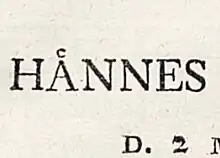
First attested in 1495.[1] Originally a ligature of A and E. During the 16th century, the letter began to be written as an A with a lower case e ontop (Aͤ respectively aͤ). During the first decades of the 18th century, the use of umlaut (Ää) emerged.
Pronunciation
- Letter name
- IPA(key): /ɛː/
- Phoneme
- IPA(key): /ɛː/, /ɛ/
Letter
Ä (upper case, lower case ä)
Declension
Lua error: attempt to perform arithmetic on local 'h' (a nil value)
References
Turkmen
See also
- Lua error in Module:utilities at line 142: attempt to perform arithmetic on local 'h' (a nil value)
Welsh
Pronunciation
- (phoneme): IPA(key): /ˈaː/, /ˌa/
Letter
Ä (lower case ä)
- The letter A, marked for its syllabic pronunciation distinct from adjacent vowels.