乏
| ||||||||
Translingual
| Stroke order | |||
Mainland China, Japan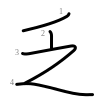 (Hong Kong, Taiwan: stroke 3 is split into two: (3A) horizontal rightward and (3B) diagonal downward.) | |||
Han character
乏 (Kangxi radical 4, 丿+4 in traditional Chinese and Korean, 丿+3 in mainland China and Japanese, 5 strokes in traditional Chinese and Korean, 4 strokes in mainland China and Japanese, cangjie input 竹戈弓人 (HINO), four-corner 20307, composition ⿱㇒之)
Derived characters
References
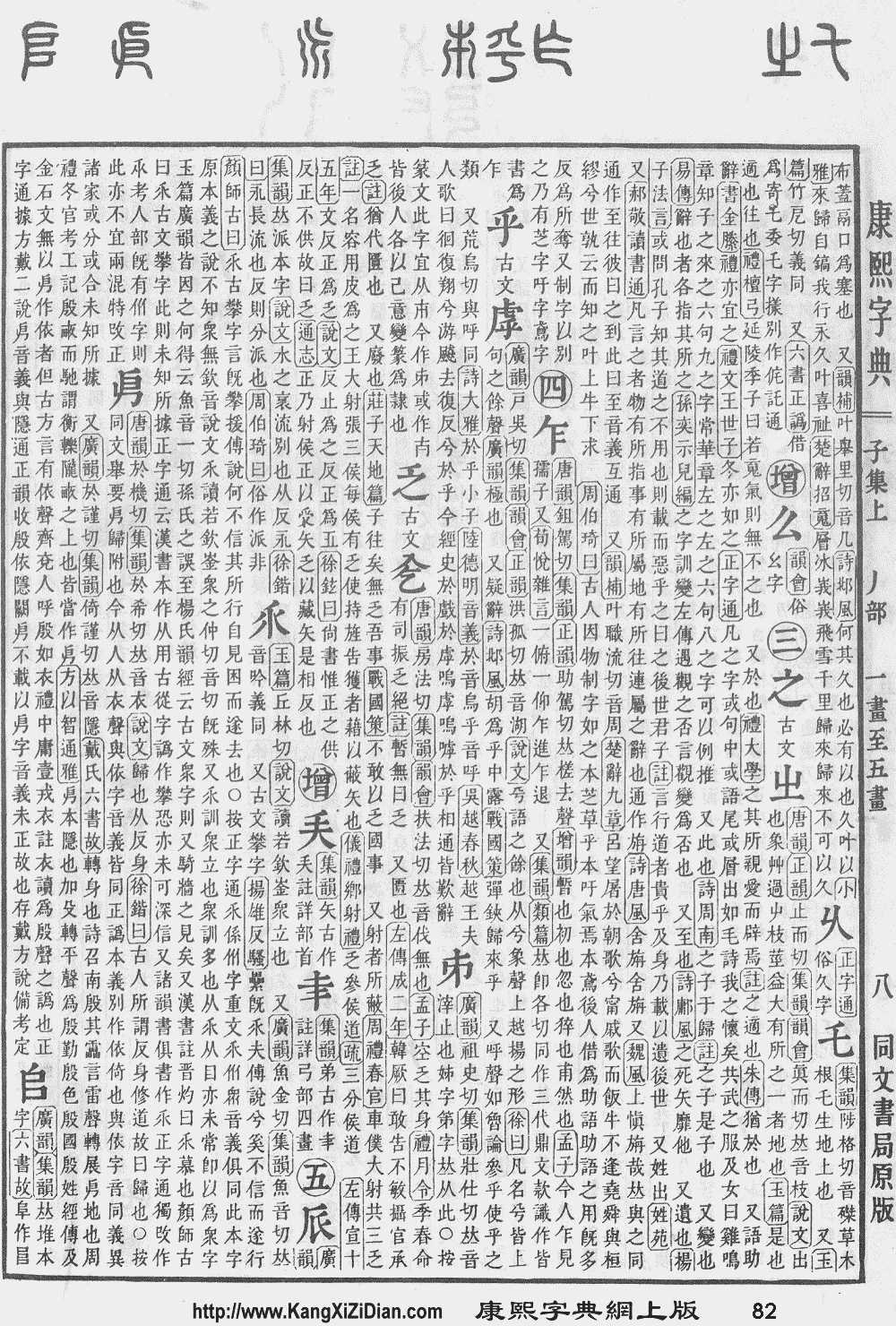
- Kangxi Dictionary: page 82, character 10
- Dai Kanwa Jiten: character 133
- Hanyu Da Zidian (first edition): volume 1, page 34, character 3
- Unihan data for U+4E4F
Chinese
| simp. and trad. |
乏 | |
|---|---|---|
| alternative forms | 𠂜 𠓟 𣥄 | |
Glyph origin
| Historical forms of the character 乏 | |||||
|---|---|---|---|---|---|
| |||||
|
References: Mostly from Richard Sears' Chinese Etymology site (authorisation),
|


Possibly an ideogram (指事) generated by replacing uppermost stroke of 正 (“straight; right”) with a slanted stroke 丿 — not right; lacking.
According to Shuowen, an ideogram (指事) created from reversing 正 (“straight; right”). This is more evident in the Small Seal Script form.
Pronunciation
Definitions
乏
Synonyms
Compounds
- 不乏 (bùfá)
- 不乏其人 (bùfáqírén)
- 不虞匱乏/不虞匮乏
- 中饋乏人/中馈乏人
- 乏人
- 乏人問津/乏人问津 (fárénwènjīn)
- 乏倦
- 乏味 (fáwèi)
- 乏善可陳/乏善可陈 (fáshànkěchén)
- 乏困 (fákùn)
- 乏地
- 乏手
- 乏月
- 乏桶
- 乏樣子/乏样子
- 乏煤
- 乏用
- 乏角兒/乏角儿
- 乏貨/乏货
- 乏趣
- 乏頓/乏顿
- 人困馬乏/人困马乏 (rénkùn-mǎfá)
- 倦乏
- 分身乏術/分身乏术 (fēnshēnfáshù)
- 力乏兵衰
- 力困筋乏
- 勞乏/劳乏
- 匱乏/匮乏 (kuìfá)
- 周急繼乏/周急继乏
- 回天乏術/回天乏术
- 回生乏術/回生乏术
- 困乏 (kùnfá)
- 害乏
- 家道消乏
- 彈性疲乏/弹性疲乏
- 後繼乏人/后继乏人
- 後繼乏力/后继乏力
- 承乏
- 振貧濟乏/振贫济乏
- 春困秋乏
- 欲振乏力
- 歇乏
- 消乏
- 疲乏 (pífá)
- 疲乏強度/疲乏强度
- 空乏
- 窮乏/穷乏 (qióngfá)
- 絕乏/绝乏 (juéfá)
- 缺乏 (quēfá)
- 謝乏/谢乏
- 貧乏/贫乏 (pínfá)
- 賑窮濟乏/赈穷济乏
- 返魂乏術/返魂乏术 (fǎnhúnfáshù)
- 道乏
- 銷乏/销乏
- 闕乏/阙乏 (quēfá)
- 養乏/养乏
References
- Dictionary of Chinese Character Variants (教育部異體字字典), A00032
- “乏”, in 漢語多功能字庫 (Multi-function Chinese Character Database), 香港中文大學 (the Chinese University of Hong Kong), 2014–
Japanese
Readings
Korean
Etymology
From Middle Chinese 乏 (MC bjop).
Compounds
References
- 국제퇴계학회 대구경북지부 (國際退溪學會 大邱慶北支部) (2007). Digital Hanja Dictionary, 전자사전/電子字典.
- Naver Hanja Dictionary: 乏
Vietnamese
Han character
乏: Hán Nôm readings: phạp, phạc
- This term needs a translation to English. Please help out and add a translation, then remove the text
{{rfdef}}.