Hessequiu
Hessequiu (Hskiu),[1] também chamado Seca (s k3), é mencionado na Pedra de Palermo como um faraó (rei) pré-dinástico do Baixo Egito. Como não há mais evidência sobre ele, talvez pode ter sido um faraó mítico preservado através da tradição oral ou um governante totalmente ficcional.[2][3][4] O nome Seca talvez possa significar "o Lavrador".[5]
| Hessequiu | ||||||||||||||
|---|---|---|---|---|---|---|---|---|---|---|---|---|---|---|
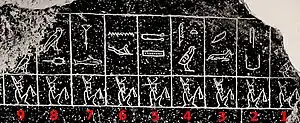 Hessequiu | ||||||||||||||
| Faraó do Baixo Egito | ||||||||||||||
| Antecessor(a) | Desconhecido | |||||||||||||
| Sucessor(a) | Caau? | |||||||||||||
| Dinastia | 0 | |||||||||||||
| Religião | Politeísmo egípcio | |||||||||||||
| ||||||||||||||


Referências
- Peake 2003, p. 63.
- Helck 1956, p. 18.
- Wilkinson 2000, p. 85.
- O'Mara 1996, p. 203.
- Morenz 2004, p. 209.
Bibliografia
- Helck, Wolfgang (1956). Untersuchungen zu Manetho und den ägyptischen Königslisten. Berlim: Akademie-Verlag
- Morenz, Ludwig D. (2004). Bild-Buchstaben und symbolische Zeichen: Die Herausbildung der Schrift der hohen Kultur Altägyptens. Friburgo: Academic Press. ISBN 3-7278-1486-1
- O'Mara, Patrick F. (1996). «Was there an Old Kingdom historiography? Is it datable?». Orientalia. 65 (3): 197-208
- Peake, Harold; Fleure, Herbert John (2003). Priests and Kings. Whitefish, Montana: Kessinger Publishing
- Wilkinson, Toby A. H. (2000). Royal Annals of Ancient Egypt. Nova Iorque: Columbia University Press. ISBN 0-7103-0667-9
This article is issued from Wikipedia. The text is licensed under Creative Commons - Attribution - Sharealike. Additional terms may apply for the media files.