de
Translingual
Symbol
de
- (international standards) ISO 639-1 language code for German.
- Coordinate term: deu
- (radio slang) from (operator), this is (operator)
English
Alternative forms
- dee (Northumberland)
Verb
de (third-person singular simple present diz, present participle dein, simple past did, past participle dyun)
- (Northumbria) Alternative form of dee (“to do”).
References
- Frank Graham (1987) The New Geordie Dictionary, →ISBN
- Newcastle 1970s, Scott Dobson and Dick Irwin,
- Northumberland Words, English Dialect Society, R. Oliver Heslop, 1893–4
- A Dictionary of North East Dialect, Bill Griffiths, 2005, Northumbria University Press, →ISBN
Article
de
- (African-American Vernacular, Bermuda, Caribbean, Jamaica) Pronunciation spelling of the.
- 1964 [1929], William Faulkner, Sartoris (The Collected Works of William Faulkner), London: Chatto & Windus, page 22:
- “He went to’ds de back, ma’am.” The negro opened the door and slid his legs, clad in army O.D. and a pair of linoleum putties, to the ground. “‘I’ll go git ’im.”’
- 2013 April 12, “Exclusive: Meet Derpuntae - Bermuda's first meme”, in The Bermuda Sun, archived from the original on 2022-12-12:
- So I'll prolly say de biggest threat to Bermy is de new selfish mentality like, she ank helpin no one in de end.
Interjection
de
- A meaningless syllable used when singing a tune or indicating a rhythm.
- "Dum de dum, dum de dum", he hummed as he sauntered down the road.
Albanian
Interjection
de
- Denotes intensity, often after imperatives or some adverbs.
- Fol de! ― Speak!
- Ashtu de! ― This manner! (expressing happiness or satisfaction for the work done)
- Hë të lumtë goja, de! ― May thy mouth be blessed!
- Spurs a horse to move: giddyup
Further reading
- “de”, in FGJSH: Fjalor i gjuhës shqipe [Dictionary of the Albanian language] (in Albanian), 2006
- “de”, in FGJSSH: Fjalor i gjuhës së sotme shqipe [Dictionary of the modern Albanian language] (in Albanian), 1980
Alemannic German
Alternative forms
Article
de
- (definite) the
- 1879, Leonhard Steiner, Glärnisch-Fahrt. Gedicht in Zürcher Mundart, p. 10:
- [...] Fründ der Natur [...]
- 1879, Leonhard Steiner, Glärnisch-Fahrt. Gedicht in Zürcher Mundart, p. 30:
- [...]; der erst und de zweit Stock [...]
- Dichtungen in Thurgauer Mundart. Gesammelt von O. Sutermeister, published in Zürich by Verlag von Orell Füßli & Co., I. Teil, p. 5:
- [...] so luted der erst Atrag, wo bi der Umfrog vom Pfleger Heieri Guetchnecht vorbrocht würd.
- Dichtungen in Thurgauer Mundart. Gesammelt von O. Sutermeister, I. Teil, p. 13:
- [...] wo die Flüchtigkeit der Zeit den Ernst des Läbens dem Gemüeti näher bringt.
- Dichtungen in Thurgauer Mundart. Gesammelt von O. Sutermeister, I. Teil, p. 34:
- [...] i siner Eigeschaft als Fürst der Höll, der [...]
- Dichtungen in Thurgauer Mundart. Gesammelt von O. Sutermeister, I. Teil, p. 52:
- Was ihr an einem der Ärmsten und Gringste Liebes und Guets tüend,
Das will ich achte, als heied ihr mir 's tue – so spricht jo der Heiland.
- Was ihr an einem der Ärmsten und Gringste Liebes und Guets tüend,
- Dichtungen in Thurgauer Mundart. Gesammelt von O. Sutermeister, II. Teil, p. 23:
- Mach mit den ander-n acht Moß, wa d'witt; [...]
- 1879, Leonhard Steiner, Glärnisch-Fahrt. Gedicht in Zürcher Mundart, p. 10:
Declension
Zürich:
| Singular | Plural | |||
|---|---|---|---|---|
| Masculine | Feminine | Neuter | ||
| Nominative | de der (before a vowel) | die, d', d'- | 's (at the beginning of a sentence or verse: S') | de, d' |
| Genitive | der | |||
| Dative | dem | der, de | dem | de |
| Accusative | de der (before a vowel) | de, d', d'- | 's | d', d'- |
Thurgau:
| Singular | Plural | |||
|---|---|---|---|---|
| Masculine | Feminine | Neuter | ||
| Nominative | de (before a consonant, including h) der (before a vowel, also before h) | die, de, d'- | das, 's | die, d'- |
| Genitive | des | der | des | der |
| Dative | dem | der | dem | de (before a consonant) den (before a vowel) |
| Accusative | de (before a consonant) der (before a vowel) den (before a vowel, less common) | die, de, d'- | das, 's | d'- |
Asturian
Usage notes
- The preposition de contracts to d' before a word beginning with a vowel or h-: d'Asturies (“of Asturias”), d'hermanu (“of a brother”).
Bambara
Pronunciation
- IPA(key): [dè]
Particle
de
- emphatic particle (placed directly after the word it modifies)
- A ma i wele. A ye ne de wele
- He didn't call you. It was me that called
References
- 2007. The UCLA Phonetics Lab Archive. Los Angeles, CA: UCLA Department of Linguistics.
Basque
Pronunciation
- IPA(key): /de/, [d̪e̞]
Declension
| indefinite | singular | plural | |
|---|---|---|---|
| absolutive | de | dea | deak |
| ergative | dek | deak | deek |
| dative | deri | deari | deei |
| genitive | deren | dearen | deen |
| comitative | derekin | dearekin | deekin |
| causative | derengatik | dearengatik | deengatik |
| benefactive | derentzat | dearentzat | deentzat |
| instrumental | dez | deaz | deez |
| inessive | detan | dean | deetan |
| locative | detako | deko | deetako |
| allative | detara | dera | deetara |
| terminative | detaraino | deraino | deetaraino |
| directive | detarantz | derantz | deetarantz |
| destinative | detarako | derako | deetarako |
| ablative | detatik | detik | deetatik |
| partitive | derik | — | — |
| prolative | detzat | — | — |
Bavarian
Alternative forms
- d' (unstressed form)
Article
de
See also
| m | n | f | pl | ||||||
|---|---|---|---|---|---|---|---|---|---|
| stressed | unstressed | stressed | unstressed | stressed | unstressed | stressed | unstressed | ||
| definite | nominative | der, da | — | das, es, des | 's | de | d' | de | d' |
| accusative | en, den | 'n | |||||||
| dative | em, dem | 'm | em, dem | 'm | der, da | — | |||
| genitive1 | des | des | der, da | der, da | |||||
| indefinite | nominative | a | — | a | — | a | — | ||
| accusative | an | 'n | |||||||
| dative | am | 'm | am | 'm | a, ana | 'na | |||
Synonyms
See also
| nominative | accusative | dative | |||||
|---|---|---|---|---|---|---|---|
| stressed | unstressed | stressed | unstressed | stressed | unstressed | ||
| 1st person singular | i | — | mi | — | mia (mir) | ma | |
| 2nd person singular (informal) |
du | — | di | — | dia (dir) | da | |
| 2nd person singular (formal) |
Sie | — | Eahna | — | Eahna | — | |
| 3rd person singular | m | er | a | eahm | 'n | eahm | 'n |
| n | es, des | 's | des | 's | |||
| f | se, de | 's | se | 's | ihr | — | |
| 1st person plural | mia (mir) | ma | uns | — | uns | — | |
| 2nd person plural | eß, ihr | — | enk, eich | — | enk, eich | — | |
| 3rd person plural | se | 's | eahna | — | eahna | — | |
Catalan
Further reading
- “de” in Diccionari de la llengua catalana, segona edició, Institut d’Estudis Catalans.
Verb
de
- inflection of dar:
- first/third-person singular present subjunctive
- third-person singular imperative
Cebuano
Preposition
de
Central Franconian
Pronunciation
- IPA(key): /də/
Article
de (definite, reduced)
- the
- (most dialects) feminine nominative and accusative
- (most dialects) plural nominative and accusative
- (many dialects) plural dative
- (some dialects) masculine nominative
- (some dialects) masculine accusative
- (few dialects) feminine dative
Usage notes
- (masculine): Three territories must be distinguished: 1.) Ripuarian, in which the accusative takes the form of the nominative; 2.) western Moselle Franconian, in which the nominative takes the form of the accusative; 3.) eastern Moselle Franconian, in which nominative and accusative are distinct.
- 1.) In Ripuarian, the reduced masculine article in nominative and accusative is de only in a few places, including Bonn; most dialects have der. The full form is always dä.
- 2.) In western Moselle Franconian, the form is de, but becomes den before vowels, h-, and dental consonants. The full form is dän.
- 3.) In eastern Moselle Franconian, the reduced masculine article in the nominative is de in many dialects, der in others. The full form is där. The accusative takes den (full form: dän).
- (feminine): Virtually all dialects use de as the reduced feminine article in nominative and accusative. The full form is die. In the dative, de is used in a few dialects of Ripuarian; the general form is der. The full form may be där or dä.
- (plural): Virtually all dialects use de as the reduced plural article in nominative and accusative. The full form is die. In the dative, de is used in most dialects of Ripuarian. In Moselle Franconian the form is the same as the masculine accusative (see above). The full form of the dative plural may be dä, dän, or däne.
- Westernmost Ripuarian has no case distinction whatsoever. Only the nominative forms are relevant for these dialects.
Declension
| definite article | ||||
|---|---|---|---|---|
| Masculine | Feminine | Neuter | Plural | |
| Nominative | de (some dialects, also some Ripuarian dialects; reduced) der (some Ripuarian dialects; reduced) dä (Ripuarian; full) |
de (most dialects; reduced) die (most dialects; full) |
de (most dialects; reduced) die (most dialects; full) | |
| Genitive | ||||
| Dative | de (few dialects; reduced) dä (Ripuarian; full) där (Moselle Franconian; full) |
de (many dialects; reduced) dä (some Ripuarian dialects; full) | ||
| Accusative | de (some dialects; reduced) dä (Ripuarian; full) |
de (most dialects; reduced) die (most dialects; full) |
de (most dialects; reduced) die (most dialects; full) | |
Ripuarian (scientific transcription by Münich with ę [ɛ] and ꝛ [ʁ]):
| Ripuarian definite article | ||||
|---|---|---|---|---|
| Masculine | Feminine | Neuter | Plural | |
| Nominative | dę | de | ət | de |
| Genitive | dęs (rare) | |||
| Dative | dęm | dę(ꝛ) | dęm | dę̄ |
| Accusative | dę | de | ət | de |
| Ripuarian demonstrative pronoun | ||||
|---|---|---|---|---|
| Masculine | Feminine | Neuter | Plural | |
| Nominative | dę̄ꝛ | dē | dat | dē |
| Genitive | des | |||
| Dative | dęm | dęꝛ | dęm | mf dęǹə n (fan) dęǹə |
| Accusative | dę̄ (dęǹə) | dē | dat | dē |
Ripuarian → Kölsch (as actually used):
| definite article | ||||
|---|---|---|---|---|
| Masculine | Feminine | Neuter | Plural | |
| Nominative | der, de, dä | die, de | dat, et, -'t | die, de |
| Genitive | des | der | des | der |
| Dative | dem | der | dem | den |
| Accusative | den, dä | die, de | dat, et, -'t | die, de |
Quotations
- 1875, Fritz Hönig, „Geschräppels.“ Humoresken. Erster Band, p. 34:
- Ha geiht no noh'm Kobes öm Veetel op Aach,
Verzällt imm dä ganzen Hergang der Saach.
- Ha geiht no noh'm Kobes öm Veetel op Aach,
Derived terms
- em (en dem)
References
- Grammatik der ripuarisch-fränkischen Mundart von Ferdinand Münch. Verlag von Friedrich Cohen, Bonn 1904, p. 138f. & 163f.
Cimbrian
Alternative forms
- di (Luserna)
Article
de
- (Sette Comuni) the; definite article for four declensions:
- nominative singular feminine
- accusative singular feminine
- nominative plural
- De diarn zeint bille un de puuben noch mèeront.
- The girls are silly, and the boys even more so.
- accusative plural
See also
| Cimbrian definite articles | ||||
|---|---|---|---|---|
| Masculine | Feminine | Neuter | Plural | |
| Nominative | dar | de / di | 's / z | de / di |
| Accusative | in | de / di | 's / z | de / di |
| Dative | me | dar | me | in |
References
- “de” in Martalar, Umberto Martello; Bellotto, Alfonso (1974) Dizionario della lingua Cimbra dei Sette Communi vicentini, 1st edition, Roana, Italy: Instituto di Cultura Cimbra A. Dal Pozzo
Danish
Etymology
From Old Danish thē, from Old Norse þeir, from Proto-Germanic *þai.
Pronunciation
- IPA(key): /di/, [d̥i]
- Rhymes: -i
Article
de pl
- plural definite article
- de grønne huse
- the green houses
- de grønne huse
Pronoun
de (as a personal pronoun, it has the forms dem in the oblique case and deres in the genitive; as a determiner, it is uninflected)
- (personal pronoun) they (third-person plural)
- (personal pronoun, nonstandard) they (gender-neutral third-person singular)
- (determiner) those
- De kager smager ikke godt.
- Those cakes taste not good.
- 2000, Mon farven har en anden lyd?: strejftog i 90'ernes musikliv og ungdomskultur i Danmark, Museum Tusculanum Press →ISBN, page 90
- De huse er meget store, både som sommerhuse og som helårshuse for de gamle hvis de flytter tilbage som pensionister uden børnene.
- Those houses are very large, both as summerhouses and all-year-houses for the old people, if they move back, being retired, without their children.
- 2015, Lynne Graham, Claire Baxter, Den lunefulde kærlighed/Min bedste ven, min elskede, Förlaget Harlequin AB →ISBN
- De borde var normalt forbeholdt VIP'erne og arrangørerne.
- Those tables were usually reserved for the VIP's and the arrangers.
See also
| Number | Person | Type | Nominative | Oblique | Possessive | ||
|---|---|---|---|---|---|---|---|
| common | neuter | plural | |||||
| Singular | First | – | jeg | mig | min | mit | mine |
| Second | modern / informal | du | dig | din | dit | dine | |
| formal | De | Dem | Deres | ||||
| Third | masculine (person) | han | ham | hans | |||
| feminine (person) | hun | hende | hendes | ||||
| common(noun) | den | dens | |||||
| neuter(noun) | det | dets | |||||
| reflexive | – | sig | sin | sit | sine | ||
| Plural | First | modern | vi | os | vores | ||
| archaic / formal | vor | vort | vore | ||||
| Second | – | I | jer | jeres | |||
| Third | – | de | dem | deres | |||
| reflexive | – | sig | |||||
Dutch
Etymology
An unstressed variety of Middle Dutch die. See die for more information.
Pronunciation
- IPA(key): /də/
Audio (file) - Hyphenation: de
- Rhymes: -ə
Article
de
- the (definite article, masculine and feminine singular, plural)
- De man ― The man (masculine singular)
- De vrouw ― The woman (feminine singular)
- Het boek ― The book (neuter singular)
- De boeken ― The books (neuter plural)
- De oude man en de zee. ― The old man and the sea.
Usage notes
Inflection
| Masculine | Feminine | Neuter | Plural | |
| Nominative | de | de | het | de |
|---|---|---|---|---|
| Genitive | des | der | des | der |
| Dative | den | der | den | den |
| Accusative | den | de | het | de |
- There is also the clitic form 's for des. The oblique cases are archaic and found in contemporary Dutch only in fixed idiomatic phrases (e.g., op den duur or des ochtends).
Derived terms
- de man
- de neus
- dezelfde
Descendants
Preposition
de
- (informal, in restricted contexts, mostly with "man") per
- Ze namen drie biertjes de man. ― They took three beers per person.
- We betaalden vijftien euro de neus. ― We paid fifteen euros per person.
Anagrams
Esperanto
Pronunciation
- IPA(key): [de]
- Audio:
(file) - Hyphenation: de
Fala
Etymology
From Old Galician-Portuguese de, from Latin dē (“of; from”).
Preposition
de
- of
- 2000, Domingo Frades Gaspar, Vamus a falal: Notas pâ coñocel y platical en nosa fala, Editora regional da Extremadura, Chapter 1: Lengua Española:
- Español falan millós de persoas.
- Millions of people speak Spanish.
Usage notes
Faroese
French
Etymology 1
From Middle French de, from Old French de, from Latin dē.
Pronunciation
- IPA(key): /də/
audio (file) - Rhymes: -ə
Preposition
de
- of (expresses belonging)
- Paris est la capitale de la France. ― Paris is the capital of France.
- 1837, Louis Viardot, chapter I, in L’Ingénieux Hidalgo Don Quichotte de la Manchefr.Wikisource, translation of El ingenioso hidalgo Don Quijote de la Mancha by Miguel de Cervantes Saavedra:
- Dans une bourgade de la Manche, dont je ne veux pas me rappeler le nom, vivait, il n’y a pas longtemps, un hidalgo ....
- In a village of La Mancha, whose name I do not want to remember, lived, not long ago, an hidalgo ....
- of (used to express property or association)
- Œuvres de Fermat ― Fermat’s Works
- Elle est la femme de mon ami. ― She is my friend’s wife.
- le voisin de Gabriel ― Gabriel's neighbor
- from (used to indicate origin)
- Elle vient de France. ― She comes from France.
- Êtes-vous de Suisse ? ― Are you from Switzerland?
- Ce fromage vient d’Espagne. ― This cheese is from Spain.
- C’est de l’ouest de la France. ― It’s from the west of France.
- Le train va de Paris à Bordeaux. ― The train goes from Paris to Bordeaux.
- of (indicates an amount)
- 5 kilos de pommes. ― 5 kilograms of apples.
- Un verre de vin ― A glass of wine
- Une portion de frites ― A portion of fries
- used attributively, often translated into English as a compound word
- Un jus de pomme ― Apple juice
- Un verre de vin ― A glass of wine
- Une boîte de nuit ― A nightclub
- Un chien de garde ― A guarddog
- Une voiture de sport ― A sportscar
- Un stade de football ― A football stadium
- from (used to indicate the start of a time or range)
- De 9:00 à 11:00 je ne serai pas libre. ― From 9 to 11 I won’t be free.
- Je travaille de huit heures à midi. ― I work from 8 o'clock to noon.
- un groupe de cinq à huit personnes ― a group of [from] five to eight people
- used after certain verbs before an infinitive, often translated into English as a gerund or an infinitive
- by (indicates the amount of change)
- Boire trois tasses par jour réduirait de 20 % les risques de contracter une maladie. ― Drinking three cups a day would reduce the risks of catching an illness by 20%.
Usage notes
Before a word beginning with a vowel sound, de elides to d’. Before the article le, it contracts with the article into du. Before the article les, it contracts with the article into des.
- Le Songe d’une nuit d’été’ ― A Midsummer Night’s Dream (literally, “The Dream of a night of summer”)
- La queue du chien ― The dog’s tail
- Index des auteurs ― Index of the authors
Article
de (indefinite)
- Used in the plural with prepositioned adjectives.
- Ce sont de bons enfants. ― They are good children.
- Il y a d’autres exemples. ― There are other examples.
- Used in negated sentences with the grammatical object.
- Elle n’a pas de mère. ― She doesn’t have a mother.
- Il ne mange pas de viande. ― He doesn’t eat meat.
- Il n’y a pas de problèmes. ― There are no problems.
Usage notes
- In negative sentences, de often replaces the indefinite (un, une and des) and partitive articles (du, de la, des). However, there are situations where the indefinite or partitive articles are retained. For example[1]:
- when the nominal element is an attributive complement to the negated verb être
- Il n’est pas un menteur. ― He isn't a liar.
- when the complement of the negated verb is followed by a contradistinctive element (not X, but Y)
- Il ne mange pas de viande. ― He doesn't eat meat.
- Il ne mange pas de la viande, mais du pain. ― He doesn't eat meat, but bread.
- when the nominal element is an attributive complement to the negated verb être
Pronunciation
- IPA(key): /dam/
References
- “de”, in Trésor de la langue française informatisé [Digitized Treasury of the French Language], 2012.
Galician
Pronunciation
- IPA(key): /dɪ/
Audio (file)
Preposition
de
Usage notes
The preposition de contracts to d- before articles, before third-person tonic pronouns, and before the determiners algún and outro.
Derived terms
| - | Singular | Plural |
|---|---|---|
| Masculine | do | dos |
| Feminine | da | das |
| - | Singular | Plural |
|---|---|---|
| Masculine | del | deles |
| Feminine | dela | delas |
Further reading
- “de” in Dicionario da Real Academia Galega, Royal Galician Academy.
Hungarian
Pronunciation
- IPA(key): [ˈdɛ]
Audio (file) - Rhymes: -dɛ
Adverb
de (not comparable)
Conjunction
de
Further reading
- (adverb): de in Bárczi, Géza and László Országh. A magyar nyelv értelmező szótára (‘The Explanatory Dictionary of the Hungarian Language’, abbr.: ÉrtSz.). Budapest: Akadémiai Kiadó, 1959–1962. Fifth ed., 1992: →ISBN
- (conjunction): de in Bárczi, Géza and László Országh. A magyar nyelv értelmező szótára (‘The Explanatory Dictionary of the Hungarian Language’, abbr.: ÉrtSz.). Budapest: Akadémiai Kiadó, 1959–1962. Fifth ed., 1992: →ISBN
- de in Ittzés, Nóra (ed.). A magyar nyelv nagyszótára (‘A Comprehensive Dictionary of the Hungarian Language’). Budapest: Akadémiai Kiadó, 2006–2031 (work in progress; published A–ez as of 2023)
Hunsrik
Alternative forms
- te (Wiesemann spelling system)
Etymology
From Middle High German der, from Old High German der, ther, replacing the original masculine and feminine nominative forms from Proto-Germanic *sa, by analogy with the adjective inflection.
Pronunciation
- IPA(key): /tə/
Article
de (definite)
- inflection of där:
- unstressed nominative/accusative singular masculine
- unstressed dative singular feminine
- unstressed dative plural all genders
Declension
Further reading
Ido
Pronunciation
- IPA(key): /de/, /dɛ/
Preposition
de
- from (indicating departure, dependency, starting point, origin or derivation)
- Me kompris la frukti de la merkato.
- I bought the fruits from the market.
- of (with a noun: indicating measurement, quantity, amount, content)
- Me esis un de kin en la konkurso.
- I was one of five in the competition.
- Me prizas tre multe tasego de kafeo ye la matino.
- I really like a big cup of coffee in the morning.
- of (with an adjective: indicating measurement, dimension)
- Me havas tri boteli plena de aquo.
- I have three bottles of water.
- with a title of nobility
- Rejio de Anglia
- Queen of England
See also
See also
- ek (“out of, out from”)
Irish
Alternative forms
- d’ (used before a vowel sound)
Pronunciation
Inflection
Derived terms
| Basic form | Contracted with | Copular forms | ||||||||
|---|---|---|---|---|---|---|---|---|---|---|
| an (“the sg”) | na (“the pl”) | mo (“my”) | do (“your”) | a (“his, her, their; which (present)”) | ár (“our”) | ar (“which (past)”) | (before consonant) | (present/future before vowel) | (past/conditional before vowel) | |
| de (“from”) | den | de na desna* | de mo dem* | de do ded*, det* | dá | dár | dar | darb | darbh | |
| do (“to, for”) | don | do na dosna* | do mo dom* | do do dod*, dot* | dá | dár | dar | darb | darbh | |
| faoi (“under, about”) | faoin | faoi na | faoi mo | faoi do | faoina | faoinár | faoinar | faoinarb | faoinarbh | |
| i (“in”) | sa, san | sna | i mo im* | i do id*, it* | ina | inár | inar | inarb | inarbh | |
| le (“with”) | leis an | leis na | le mo lem* | le do led*, let* | lena | lenár | lenar | lenarb | lenarbh | |
| ó (“from, since”) | ón | ó na ósna* | ó mo óm* | ó do ód*, ót* | óna | ónár | ónar | ónarb | ónarbh | |
| trí (“through”) | tríd an | trí na | trí mo | trí do | trína | trínár | trínar | trínarb | trínarbh | |
| *Dialectal. | ||||||||||
See also: Category:Irish phrasal verbs with particle (de)
References
- Quiggin, E. C. (1906) A Dialect of Donegal, Cambridge University Press, page 73
- Quiggin, E. C. (1906) A Dialect of Donegal, Cambridge University Press, page 19


Further reading
- Ó Dónaill, Niall (1977), “de”, in Foclóir Gaeilge–Béarla, Dublin: An Gúm, →ISBN
- G. Toner, M. Ní Mhaonaigh, S. Arbuthnot, D. Wodtko, M.-L. Theuerkauf, editors (2019), “1 de, di”, in eDIL: Electronic Dictionary of the Irish Language
- Entries containing “de” in English-Irish Dictionary, An Gúm, 1959, by Tomás de Bhaldraithe.
- Entries containing “de” in New English-Irish Dictionary by Foras na Gaeilge.
Italian
Contraction
de
- Apocopic form of del
- Michael Radford è il regista de "Il postino". ― Michael Radford is the director of "Il Postino".
Usage notes
De is used where del, della, etc, would ordinarily be used, but cannot be because the article is part of the title of a film, book, etc.
See also
Jersey Dutch
Pronunciation
- IPA(key): /də/
Article
de
- the
- 1912, Tijdschrift voor Nederlandsche taal— en letterkunde, volumes 31-32, page 309:
- De v'lôrene zön
- The prodigal (literally "lost") son
- De v'lôrene zön
- 1912, Tijdschrift voor Nederlandsche taal— en letterkunde, volumes 31-32, page 309:
Ladino
Lashi
Etymology 1
From Proto-Lolo-Burmese [Term?], from Proto-Sino-Tibetan *daj (“do, make”). Cognates include Ao da (“do”) and Lahu te (“do”).
Pronunciation
- IPA(key): /deː˧/
Pronunciation
- IPA(key): /de˧/
Latin
Pronunciation
- (Classical) IPA(key): /deː/, [d̪eː]
- (modern Italianate Ecclesiastical) IPA(key): /de/, [d̪ɛː]
Coordinate terms
References
- de in Charlton T. Lewis and Charles Short (1879) A Latin Dictionary, Oxford: Clarendon Press
- de in Charlton T. Lewis (1891) An Elementary Latin Dictionary, New York: Harper & Brothers
- de in Charles du Fresne du Cange’s Glossarium Mediæ et Infimæ Latinitatis (augmented edition with additions by D. P. Carpenterius, Adelungius and others, edited by Léopold Favre, 1883–1887)
- de in Gaffiot, Félix (1934) Dictionnaire illustré latin-français, Hachette
- Carl Meißner; Henry William Auden (1894) Latin Phrase-Book, London: Macmillan and Co.
- the vegetable kingdom: arbores stirpesque, herbae stirpesque (De Fin. 5. 11. 33)
- to take root: radices agere (De Off. 2. 12. 73)
- to be struck by lightning: de caelo tangi, percuti
- to turn aside from the right way; to deviate: de via declinare, deflectere (also metaphorically)
- make way for any one: (de via) decedere alicui
- weary with travelling; way-worn: fessus de via
- to leave a place: discedere a, de, ex loco aliquo
- to quit a place for ever: decedere loco, de, ex loco
- to throw oneself from the ramparts: se deicere de muro
- to throw some one down the Tarpeian rock: deicere aliquem de saxo Tarpeio
- while it is still night, day: de nocte, de die
- late at night: multa de nocte
- a fine, practised ear: aures elegantes, teretes, tritae (De Or. 9. 27)
- to pass a thing from hand to hand: de manu in manus or per manus tradere aliquid
- to wrest from a person's hand: ex or de manibus alicui or alicuius extorquere aliquid
- to slip, escape from the hands: e (de) manibus effugere, elābi
- the world of sense, the visible world: res sensibus or oculis subiectae (De Fin. 5. 12. 36)
- to free one's mind from the influences of the senses: sevocare mentem a sensibus (De Nat. D. 3. 8. 21)
- from one's entry into civil life: ab ineunte (prima) aetate (De Or. 1. 21. 97)
- to dream of a person: somniare de aliquo
- to depart this life: (de) vita decedere or merely decedere
- to depart this life: de vita exire, de (ex) vita migrare
- to remove a person: e or de medio tollere
- I'm undone! it's all up with me: perii! actum est de me! (Ter. Ad. 3. 2. 26)
- for valid reasons: iustis de causis
- to comfort a man in a matter; to condole with him: consolari aliquem de aliqua re
- to deserve well at some one's hands; to do a service to..: bene, praeclare (melius, optime) mereri de aliquo
- to deserve ill of a person; to treat badly: male mereri de aliquo
- to expostulate with a person about a thing: conqueri, expostulare cum aliquo de aliqua re
- to inform a person: certiorem facere aliquem (alicuius rei or de aliqua re)
- to mention a thing: mentionem facere alicuius rei or de aliqua re
- to mention a thing incidentally, casually: mentionem inicere de aliqua re or Acc. c. Inf.
- to detract from a person's reputation, wilfully underestimate a person: de gloria, fama alicuius detrahere
- to have a good or bad reputation, be spoken well, ill of: bona, mala existimatio est de aliquo
- to do work (especially agricultural): opus facere (De Senect. 7. 24)
- to exert oneself very considerably in a matter: desudare et elaborare in aliqua re (De Senect. 11. 38)
- to study the commonplace: cogitationes in res humiles abicere (De Amic. 9. 32) (Opp. alte spectare, ad altiora tendere, altum, magnificum, divinum suspicere)
- vague, undeveloped ideas: intellegentiae adumbratae or incohatae (De Leg. 1. 22. 59)
- to give up one's opinion: de sententia sua decedere
- to give up one's opinion: (de) sententia desistere
- to be forced to change one's mind: de sententia deici, depelli, deterreri
- to make a man change his opinion: de sententia aliquem deducere, movere
- to judge others by oneself: de se (ex se de aliis) coniecturam facere
- to form a plan, make a resolution: consilium capere, inire (de aliqua re, with Gen. gerund., with Inf., more rarely ut)
- to deliberate together (of a number of people): consilium habere (de aliqua re)
- to deliberate, consider (of individuals): consultare or deliberare (de aliqua re)
- designedly; intentionally: de industria, dedita opera (opp. imprudens)
- from memory; by heart: ex memoria (opp. de scripto)
- to reduce a thing to its theoretical principles; to apply theory to a thing: ad artem, ad rationem revocare aliquid (De Or. 2. 11. 44)
- to apply oneself very closely to literary, scientific work: in litteris elaborare (De Sen. 8. 26)
- to be a man of great learning: doctrina abundare (De Or. 3. 16. 59)
- abstruse studies: studia, quae in reconditis artibus versantur (De Or. 1. 2. 8)
- to have a thorough grasp of a subject: penitus percipere et comprehendere aliquid (De Or. 1. 23. 108)
- for a Roman he is decidedly well educated: sunt in illo, ut in homine Romano, multae litterae (De Sen. 4. 12)
- to civilise men, a nation: homines, gentem a fera agrestique vita ad humanum cultum civilemque deducere (De Or. 1. 8. 33)
- to obtain a result in something: aliquid efficere, consequi in aliqua re (De Or. 1. 33. 152)
- he is a young man of great promise: adulescens alios bene de se sperare iubet, bonam spem ostendit or alii de adulescente bene sperare possunt
- to take a lesson from some one's example: sibi exemplum sumere ex aliquo or exemplum capere de aliquo
- to give advice, directions, about a matter: praecepta dare, tradere de aliqua re
- Cicero's philosophical writings: Ciceronis de philosophia libri
- Solon, one of the seven sages: Solo, unus de septem (illis)
- to teac: tradere (aliquid de aliqua re)
- dialectical nicety: disserendi subtilitas (De Or. 1. 1. 68)
- moral science; ethics: philosophia, quae est de vita et moribus (Acad. 1. 5. 19)
- moral science; ethics: philosophia, in qua de bonis rebus et malis, deque hominum vita et moribus disputatur
- to systematise: ad rationem, ad artem et praecepta revocare aliquid (De Or. 1. 41)
- to determine the nature and constitution of the subject under discussion: constituere, quid et quale sit, de quo disputetur
- the points on which proofs are based; the grounds of proof: loci (τόποι) argumentorum (De Or. 2. 162)
- to discuss, investigate a subject scientifically: disputare (de aliqua re, ad aliquid)
- to discuss both sides of a question: in utramque partem, in contrarias partes disputare (De Or. 1. 34)
- to be contested, become the subject of debate: in controversiam vocari, adduci, venire (De Or. 2. 72. 291)
- the point at issue: id, de quo agitur or id quod cadit in controversiam
- a twofold tradition prevails on this subject: duplex est memoria de aliqua re
- to write poetry with facility: carmina , versus fundere (De Or. 3. 50)
- to learn to play a stringed instrument: fidibus discere (De Sen. 8. 26)
- the melody: modi (De Or. 1. 42. 187)
- the art of painting: ars pingendi, pictura (De Or. 2. 16. 69)
- the dramatic art: ars ludicra (De Or. 2. 20. 84)
- to retire from the stage: de scaena decedere
- to be fluent: disertum esse (De Or. 1. 21. 94)
- to be a capable, finished speaker: eloquentem esse (De Or. 1. 21. 94)
- flow of oratory: flumen orationis (De Or. 2. 15. 62)
- incorrect language: oratio inquinata (De Opt. Gen. Or. 3. 7)
- flowers of rhetoric; embellishments of style: lumina, flores dicendi (De Or. 3. 25. 96)
- to give an account of a thing (either orally or in writing): exponere aliquid or de aliqua re
- to make a character-sketch of a person: de ingenio moribusque alicuius exponere
- graphic depiction: rerum sub aspectum paene subiectio (De Or. 3. 53. 202)
- to go deeply into a matter, discuss it fully: multum, nimium esse (in aliqua re) (De Or. 2. 4. 17)
- to speak at great length on a subject, discuss very fully: fusius, uberius, copiosius disputare, dicere de aliqua re
- to interpolate, insert something: interponere aliquid (De Am. 1. 3)
- to digress, deviate: digredi (a proposito) (De Or. 2. 77. 311)
- a rather recondite speech: oratio longius repetita (De Or. 3. 24. 91)
- to read a speech: de scripto orationem habere, dicere (opp. sine scripto, ex memoria)
- the arrangement of the subject-matter: dispositio rerum (De Inv. 1. 7. 9)
- to set some one a theme for discussion: ponere alicui, de quo disputet
- to let those present fix any subject they like for discussion: ponere iubere, qua de re quis audire velit (Fin. 2. 1. 1)
- the question at issue: res, de qua nunc quaerimus, quaeritur
- to answer every question: percontanti non deesse (De Or. 1. 21. 97)
- a far-fetched joke: arcessitum dictum (De Or. 2. 63. 256)
- to be silly, without tact: ineptum esse (De Or. 2. 4. 17)
- to be united by having a common language: eiusdem linguae societate coniunctum esse cum aliquo (De Or. 3. 59. 223)
- to translate from Plato: ab or de (not ex) Platone vertere, convertere, transferre
- a linguist, philologian: grammaticus (De Or. 1. 3. 10)
- to employ carefully chosen expressions: lectissimis verbis uti (De Or. 3. 37)
- to say not a syllable about a person: ne verbum (without unum) quidem de aliquo facere
- to speak on a subject: verba facere (de aliqua re, apud aliquem)
- to begin with a long syllable: oriri a longa (De Or. 1. 55. 236)
- to compose, compile a book: librum conficere, componere (De Sen. 1. 2)
- there exists a book on..: est liber de...
- the book treats of friendship: hic liber est de amicitia (not agit) or hoc libro agitur de am.
- to lay down a book (vid. sect. XII. 3, note vestem deponere...): librum de manibus ponere
- humour; disposition: animi affectio or habitus (De Inv. 2. 5)
- I am pained, vexed, sorry: doleo aliquid, aliqua re, de and ex aliqua re
- not to trouble oneself about a thing: non laborare de aliqua re
- to disconcert a person: animum alicuius de statu, de gradu demovere (more strongly depellere, deturbare)
- to lose one's composure; to be disconcerted: de statu suo or mentis deici (Att. 16. 15)
- to lose one's composure; to be disconcerted: de gradu deici, ut dicitur
- what will become of me: quid (de) me fiet? (Ter. Heaut. 4. 3. 37)
- it's all over with me; I'm a lost man: actum est de me
- to hope well of a person: bene, optime (meliora) sperare de aliquo (Nep. Milt. 1. 1)
- to fulfil expectation: exspectationem explere (De Or. 1. 47. 205)
- to be touched with pity: misericordia moveri, capi (De Or. 2. 47)
- to have enthusiasm for a person or thing: studio ardere alicuius or alicuius rei (De Or. 2. 1. 1)
- to undermine a person's loyalty: de fide deducere or a fide abducere aliquem
- to make a thing credible: fidem facere, afferre alicui rei (opp. demere, de-, abrogare fidem)
- to be answerable for a person, a thing: praestare aliquem, aliquid, de aliqua re or Acc. c. Inf.
- to suspect a person: suspicionem habere de aliquo
- to be separated by a deadly hatred: capitali odio dissidere ab aliquo (De Am. 1. 2)
- to vent one's anger, spite on some one: virus acerbitatis suae effundere in aliquem (De Amic. 23. 87)
- his vices betray themselves: vitia erumpunt (in aliquem) (De Amic. 21. 76)
- to give some one satisfaction for an injury: satisfacere alicui pro (de) iniuriis
- apparently; to look at: specie (De Amic. 13. 47)
- to neglect one's duty: de, ab officio decedere
- to follow one's inclinations: studiis suis obsequi (De Or. 1. 1. 3)
- moral precepts: praecepta de moribus or de virtute
- to give moral advice, rules of conduct: de virtute praecipere alicui
- by divine inspiration (often = marvellously, excellently): divinitus (De Or. 1. 46. 202)
- to observe the sky (i.e. the flight of birds, lightning, thunder, etc.: de caelo servare (Att. 4. 3. 3)
- to escort a person from his house: deducere aliquem de domo
- to be a strict disciplinarian in one's household: severum imperium in suis exercere, tenere (De Sen. 11. 37)
- to dispossess a person: demovere, deicere aliquem de possessione
- to live on one's means: de suo (opp. alieno) vivere
- a sociable, affable disposition: facilitas, faciles mores (De Am. 3. 11)
- to turn the conversation on to a certain subject: sermonem inferre de aliqua re
- the conversation turned on..: sermo incidit de aliqua re
- to converse, talk with a person on a subject: sermonem habere cum aliquo de aliqua re (De Am. 1. 3)
- to exchange greetings: inter se consalutare (De Or. 2. 3. 13)
- to congratulate a person on something: gratulari alicui aliquid or de aliqua re
- to separate, be divorced (used of man or woman): nuntium remittere alicui (De Or. 1. 40)
- disinherited: exheres paternorum bonorum (De Or. 1. 38. 175)
- to introduce a thing into our customs; to familiarise us with a thing: in nostros mores inducere aliquid (De Or. 2. 28)
- to transact, settle a matter with some one: transigere aliquid (de aliqua re) cum aliquo or inter se
- to subtract something from the capital: de capite deducere (vid. sect. XII. 1, note Notice too...) aliquid
- to demand an account, an audit of a matter: rationem ab aliquo reptere de aliqua re (Cluent. 37. 104)
- credit has disappeared: fides (de foro) sublata est (Leg. Agr. 2. 3. 8)
- to have pecuniary difficulties: laborare de pecunia
- as you sow, so will you reap: ut sementem feceris, ita metes (proverb.) (De Or. 2. 65)
- to plant trees: arbores serere (De Sen. 7. 24)
- to have the good of the state at heart: bene, optime sentire de re publica
- to have the good of the state at heart: omnia de re publica praeclara atque egregia sentire
- the head of the state: rector civitatis (De Or. 1. 48. 211)
- statesmanship; political wisdom: prudentia (civilis) (De Or. 1. 19. 85)
- to foresee political events long before: longe prospicere futuros casus rei publicae (De Amic. 12. 40)
- one of the people: homo plebeius, de plebe
- one of the crowd; a mere individual: unus de or e multis
- to overthrow a person (cf. sect. IX. 6): aliquem de dignitatis gradu demovere
- to overthrow a person (cf. sect. IX. 6): aliquem gradu movere, depellere or de gradu (statu) deicere
- deposed from one's high position: de principatu deiectus (B. G. 7. 63)
- to contend with some one for the pre-eminence: contendere cum aliquo de principatu (Nep. Arist. 1)
- to record in the official tablets (Annales maximi): in album referre (De Or. 2. 12. 52)
- to have the same political opinions: idem de re publica sentire
- to form a conspiracy: coniurare (inter se) de c. Gerund. or ut...
- to banish a person, send him into exile: de, e civitate aliquem eicere
- to expel a person from the city, country: exterminare (ex) urbe, de civitate aliquem (Mil. 37. 101)
- a returning from exile to one's former privileges: postliminium (De Or. 1. 40. 181)
- to shake hands with voters in canvassing: manus prensare (De Or. 1. 24. 112)
- to give up, lay down office (usually at the end of one's term of office): de potestate decedere
- men of rank and dignity: viri clari et honorati (De Sen. 7. 22)
- a man who has held many offices: honoribus ac reipublicae muneribus perfunctus (De Or. 1. 45)
- to offically proclaim (by the praeco, herald) a man elected consul; to return a man consul: aliquem consulem renuntiare (De Or. 2. 64. 260)
- to consult the senators on a matter: patres (senatum) consulere de aliqua re (Sall. Iug. 28)
- the senate inclines to the opinion, decides for..: senatus sententia inclīnat ad... (De Sen. 6. 16)
- what is your opinion: quid de ea re fieri placet?
- to waive one's right: de iure suo decedere or cedere
- to hold an inquiry into a matter: quaerere aliquid or de aliqua re
- to examine a person, a matter: quaestionem habere de aliquo, de aliqua re or in aliquem
- to have a person tortured: quaerere tormentis de aliquo
- to examine slaves by torture: de servis quaerere (in dominum)
- counsel; advocate: patronus (causae) (De Or. 2. 69)
- to strike a person's name off the list of the accused: eximere de reis aliquem
- to accuse a person of extortion (to recover the sums extorted): postulare aliquem repetundarum or de repetundis
- to accuse some one of illegal canvassing: accusare aliquem ambitus, de ambitu
- to accuse a person of violence, poisoning: accusare aliquem de vi, de veneficiis
- to decide on the conduct of the case: iudicare causam (de aliqua re)
- to exact a penalty from some one: supplicium sumere de aliquo
- to atone for something by..: luere aliquid aliqua re (De Sen. 20)
- to execute the death-sentence on a person: supplicium sumere de aliquo
- to congratulate a person on his victory: victoriam or de victoria gratulari alicui
- to triumph over some one: triumphare de aliquo (ex bellis)
- to triumph over some one: triumphum agere de or ex aliquo or c. Gen. (victoriae, pugnae)
- to treat with some one about peace: agere cum aliquo de pace
- to stop rowing; to easy: sustinere, inhibere remos (De Or. 1. 33)
- to land, disembark: exire ex, de navi
- not to mention..: ut non (nihil) dicam de...
- this can be said of..., applies to..: hoc dici potest de aliqua re
- I have a few words to say on this: mihi quaedam dicenda sunt de hac re
- more of this another time: sed de hoc alias pluribus
- so much for this subject...; enough has been said on..: atque haec quidem de...
- so much for this subject...; enough has been said on..: ac (sed) de ... satis dixi, dictum est
- I am sorry to hear..: male (opp. bene) narras (de)
- but enough: sed manum de tabula!
- the vegetable kingdom: arbores stirpesque, herbae stirpesque (De Fin. 5. 11. 33)
- de in Enrico Olivetti, editor (2003-2024) Dizionario Latino, Olivetti Media Communication
- Arthur E. Gordon, The Letter Names of the Latin Alphabet (University of California Press, 1973; volume 9 of University of California Publications: Classical Studies), part III: “Summary of the Ancient Evidence”, page 32: "Clearly there is no question or doubt about the names of the vowels A, E, I, O, U. They are simply long A, long E, etc. (ā, ē, ī, ō, ū). Nor is there any uncertainty with respect to the six mutes B, C, D, G, P, T. Their names are bē, cē, dē, gē, pē, tē (each with a long E). Or about H, K, and Q: they are hā, kā, kū—each, again, with a long vowel sound."
- (2012) The Unicode Consortium, The Unicode Standard: Version 6.1 – Core Specification. →ISBN, page 468; citing: (1985) Geoffrey Sampson, Writing Systems: A Linguistic Introduction, Stanford, CA: Stanford University Press. →ISBN.
Etymology 2
From Proto-Italic *dē, ultimately from Proto-Indo-European *de. Also in suffixes -dam, -dum, -de, -dō (e.g. quondam, inde, unde, quandō), dōnec, Ancient Greek δέ (dé), δή (dḗ), English to.
All 3 ablative senses are from the PIE ablative of cause, origin, and separation.
Pronunciation
- (Classical) IPA(key): /deː/, [d̪eː]
- (modern Italianate Ecclesiastical) IPA(key): /de/, [d̪ɛː]
Audio (Classical) (file)
Preposition
dē (+ ablative)
- of, concerning, about
- actum est de aliquo ― It is over for someone, the fate of someone is sealed
- De rebus mathematicis. ― Concerning mathematical things.
- from, away from, down from, out of; in general to indicate the person or place from which any thing is taken, etc., with verbs of taking away, depriving, demanding, requesting, inquiring, buying; as capere, sumere, emere, quaerere, discere, trahere, etc., and their compounds.
- Emere de aliquo. ― To buy from someone.
- Aliquid mercari de aliquo. ― To buy something from someone.
- De aliquo quaerere, quid, etc., C ― To search for someone.
- Saepe hoc audivi de patre. ― I have often heard this from father.
- De mausoleo exaudita vox est. ― A voice was heard from the mausoleum.
- Ut sibi liceret discere id de me. ― Just as he himself permitted for me to learn.
- Hamum de cubiculo ut e navicula jacere. ― (please add an English translation of this usage example)
- Brassica de capite et de oculis omnia (mala) deducet. ― (please add an English translation of this usage example)
- De digito anulum detraho. ― From the finger I pull the ring.
- De matris complexu aliquem avellere atque abstrahere. ― (please add an English translation of this usage example) (literally, “I rip someone away from the embrace of their mother and drag them away.”)
- Nomen suum de tabula sustulit. ― He removed his name from the tablet.
- Ferrum de manibus extorsimus. ― We tore the sword from their hands.
- Juris utilitas vel a peritis vel de libris depromi potest. ― The utility of a law is able to be produced either from an expert or from books.
- De caelo aliquid demittere. ― To bring down something from the sky.
- with petere, of a place
- De vicino terra petita solo. ― (please add an English translation of this usage example)
- (Late Latin) of persons
- Peto de te. ― I beg of thee.
- from, away from, to indicate the place from which someone or something departs or withdraws.
- Animam de corpore mitto. ― I release the spirit from the body.
- Aliquo quom jam sucus de corpore cessit. ― Somehow the spirit has already passed somewhere from the body.
- Civitati persuasit, ut de finibus suis cum omnibus copiis exirent. ― He persuaded the people to go forth from their territories with all their possessions.
- Decedere de provincia. ― To retire from office.
- De vita decedere. ― To withdraw from life
- Exire de vita. ― to exit out of life. (compare excedere e vita)
- De triclinio, de cubiculo exire. ― To go out from the triclinium, from the cubiculum.
- De castris procedere. ― To proceed out of the military camps.
- ...decido de lecto praeceps. ― I fall down from the bed headlong.
- De muro se deicere. ― To throw oneself down from the wall.
- De sella exsilire. ― To jump from the stool.
- Nec ex equo vel de muro etc., hostem destinare. ― To aim at the enemy from neither the horse nor the wall.
- De altera parte tertia Sequanos decedere juberet. ― He ordered the Sequani to withdraw from another third part.
- (particularly coins) over, in reference to the people subjugated when celebrating a Roman victory
- De Germanis
- Over the Germans
- De Britannis
- Over the Britons
Usage notes
- Dē denotes the going out, departure, removal, or separating of an object from any fixed point (it occupies a middle place between ab (“away from”) which denotes a mere external departure, and ex (“out of”) which signifies from the interior of a thing). Hence verbs compounded with dē are constructed not only with dē, but quite as frequently with ab and ex; and, on the other hand, those compounded with ab and ex often have the terminus a quo indicated by dē.
Derived terms
Descendants
- Aragonese: de
- Asturian: de
- Aromanian: di
- Old Catalan: de
- Catalan: de
- Corsican: di
- Dalmatian: de
- → Esperanto: de
- Franco-Provençal: de
- Old French: de
- Friulian: di
- Mozarabic: ד (d)
- Old Galician-Portuguese: de
- → Ido: de
- → Interlingua: de
- Italian: di
- Ladin: de
- Ladino: de
- Mozarabic: ד (d)
- Neapolitan: 'e
- Old Occitan: de
- Occitan: de
- Romanian: de
- Romansch: da
- Sicilian: di
- Old Spanish: de
- Spanish: de
Ligurian
Pronunciation
- IPA(key): /de/
Louisiana Creole
| < 1 | 2 | 3 > |
|---|---|---|
| Cardinal : de Ordinal : sègon Multiplier : doub Collective : toulédé | ||
Pronunciation
- IPA(key): /dø/
- Rhymes: -ø
Low German
Alternative forms
Etymology
From Middle Low German dê, from Old Saxon thē.
Pronunciation
- IPA(key): /deː/, /deɪ/, /dɛɪ̯/
Article
de m or f (neuter dat, plural de)
- the
- De Mann gat hen. ― The man walks [lit. goes] there.
- De Fru geiht hen. ― The woman walks [lit. goes] there.
- dat Sakramänt der Eihe (Paderbornisch) ― the sacrament of marriage
Usage notes
- Dative and accusative are sometimes called 'object case'. However, most (if not all) dialects have not actually merged these two.
- There is the only plural article and like English 'the' is used for nouns of every gender and class. Indefinite nouns in plural are used without article, again as in English.
Pronoun
de m or f (neuter dat)
Usage notes
- The use as a relative pronoun might not be present in all dialects.
Luxembourgish
Pronunciation
- IPA(key): [də]
Declension
| nominative | accusative | dative | reflexive | ||||||
|---|---|---|---|---|---|---|---|---|---|
| str. | unstr. | str. | unstr. | str. | unstr. | ||||
| 1st person singular | ech | — | mech | — | mir | mer | like dat. and acc. | ||
| 2nd person singular (informal) |
du | de | dech | — | dir | der | like dat. and acc. | ||
| 2nd person singular (formal) |
Dir | Der | Iech | Iech [əɕ] | Iech | Iech [əɕ] | Iech | ||
| 3rd person singular | m | hien | en | hien | en | him | em | sech | |
| f | si | se | si | se | hir | er | sech | ||
| n | hatt | et ('t) | hatt | et ('t) | him | em | sech | ||
| 1st person plural | mir | mer | eis (ons) | — | eis (ons) | — | eis (ons) | ||
| 2nd person plural | dir | der | iech | iech [əɕ] | iech | iech [əɕ] | iech | ||
| 3rd person plural | si | se | si | se | hinnen | en | sech | ||
Mandarin
Romanization
- Hanyu Pinyin reading of 地
- Hanyu Pinyin reading of 底
- Hanyu Pinyin reading of 得
- Hanyu Pinyin reading of 的
- Hanyu Pinyin reading of 脦
- Hanyu Pinyin reading of 𠵨
- Hanyu Pinyin reading of の
Romanization
de
Usage notes
- Transcriptions of Mandarin into the Latin script often do not distinguish between the critical tonal differences employed in the Mandarin language, using words such as this one without indication of tone.
Mauritian Creole
| < 1 | 2 | 3 > |
|---|---|---|
| Cardinal : de Ordinal : deziem Adverbial : ledoub | ||
Pronunciation
- IPA(key): /de/
Derived terms
Middle Dutch
Article
de
- inflection of die:
- masculine nominative singular
- feminine nominative/accusative singular
- nominative/accusative plural
Mirandese
Mòcheno
Etymology
From Middle High German diu, from Old High German diu, from Proto-Germanic *þō, an alteration of *sō. Cognate with German die, obsolete English tho.
Article
de (singular masculine der, singular neuter s)
- the, nominative singular feminine definite article
- the, nominative plural definite article
References
- “de” in Cimbrian, Ladin, Mòcheno: Getting to know 3 peoples. 2015. Servizio minoranze linguistiche locali della Provincia autonoma di Trento, Trento, Italy.
Northern Kurdish
Northern Ndebele
Etymology
From Proto-Bantu *-dàì.
Inflection
| Adjective concord, tone L | ||
|---|---|---|
| Modifier | Copulative | |
| 1st singular | engimude | ngimude |
| 2nd singular | omude | umude |
| 1st plural | esibade | sibade |
| 2nd plural | elibade | libade |
| Class 1 | omude | mude |
| Class 2 | abade | bade |
| Class 3 | omude | mude |
| Class 4 | emide | mide |
| Class 5 | elide | lide |
| Class 6 | amade | made |
| Class 7 | eside | side |
| Class 8 | ezinde | zinde |
| Class 9 | ende | inde |
| Class 10 | ezinde | zinde |
| Class 11 | olude | lude |
| Class 14 | obude | bude |
| Class 15 | okude | kude |
| Class 17 | okude | kude |
Northern Sami
Etymology
(This etymology is missing or incomplete. Please add to it, or discuss it at the Etymology scriptorium.)
Pronunciation
- (Kautokeino) IPA(key): /ˈte/
Further reading
Norwegian Bokmål
Pronunciation
Audio (file) - IPA(key): /diː/
Article
de
- definite article, equivalent to "the", used before adjectives used with plural nouns; also used before adjectives converted to nouns. Usually capitalised as "De" when used in proper nouns.
See also
| Number | Person | Type | Nominative | Oblique | Possessive | |||
|---|---|---|---|---|---|---|---|---|
| feminine | masculine | neuter | plural | |||||
| Singular | First | – | jeg | meg | mi | min | mitt | mine |
| Second | general | du | deg | di | din | ditt | dine | |
| formal (rare) | De | Dem | Deres | |||||
| Third | feminine (person) | hun | henne | hennes | ||||
| masculine (person) | han | ham / han | hans | |||||
| feminine (noun) | den | dens | ||||||
| masculine (noun) | ||||||||
| neuter (noun) | det | dets | ||||||
| reflexive | – | seg | si | sin | sitt | sine | ||
| Plural | First | – | vi | oss | vår | vårt | våre | |
| Second | general | dere | deres | |||||
| formal (very rare) | De | Dem | Deres | |||||
| Third | general | de | dem | deres | ||||
| reflexive | – | seg | si | sin | sitt | sine | ||
References
- “de” in The Bokmål Dictionary.
Norwegian Nynorsk
Etymology 1
From Old Norse þér, ér and þit, it. From a variant of Proto-Germanic *jūz, from Proto-Indo-European *yū́.
Pronunciation
- IPA(key): /deː/, /diː/
Synonyms
See also
| person | first person | second person | reflexive | third person | ||
|---|---|---|---|---|---|---|
| case | singular | singular masculine | singular feminine | singular neuter | ||
| nominative | eg, je1 | du | han | ho | det, dat2 | |
| accusative | meg | deg | seg | han, honom2 | ho, henne2 | det, dat2 |
| dative2 | meg | deg | seg | honom | henne | di2 |
| genitive | min | din | sin | hans | hennar, hennes1 | dess3 |
| case | plural | |||||
| nominative | me, vi | de, dokker | dei | |||
| accusative | oss, okk | dykk, dokker | seg | dei, deim2 | ||
| dative | oss, okk | dykk, dokker | seg | deim2 | ||
| genitive | vår, okkar | dykkar, dokkar | sin | deira, deires1 | ||
References
- “de” in The Nynorsk Dictionary.
- “de” in Ivar Aasen (1873) Norsk Ordbog med dansk Forklaring
- Ivar Aasen (1850), “did”, in Ordbog over det norske Folkesprog, Oslo: Samlaget, published 2000
Occitan
Alternative forms
- d' (before a vowel)
Old French
Usage notes
- before a vowel, either remains as a separate word or becomes d'
Old Galician-Portuguese
Alternative forms
Pronunciation
- IPA(key): /de/
Preposition
de
- of
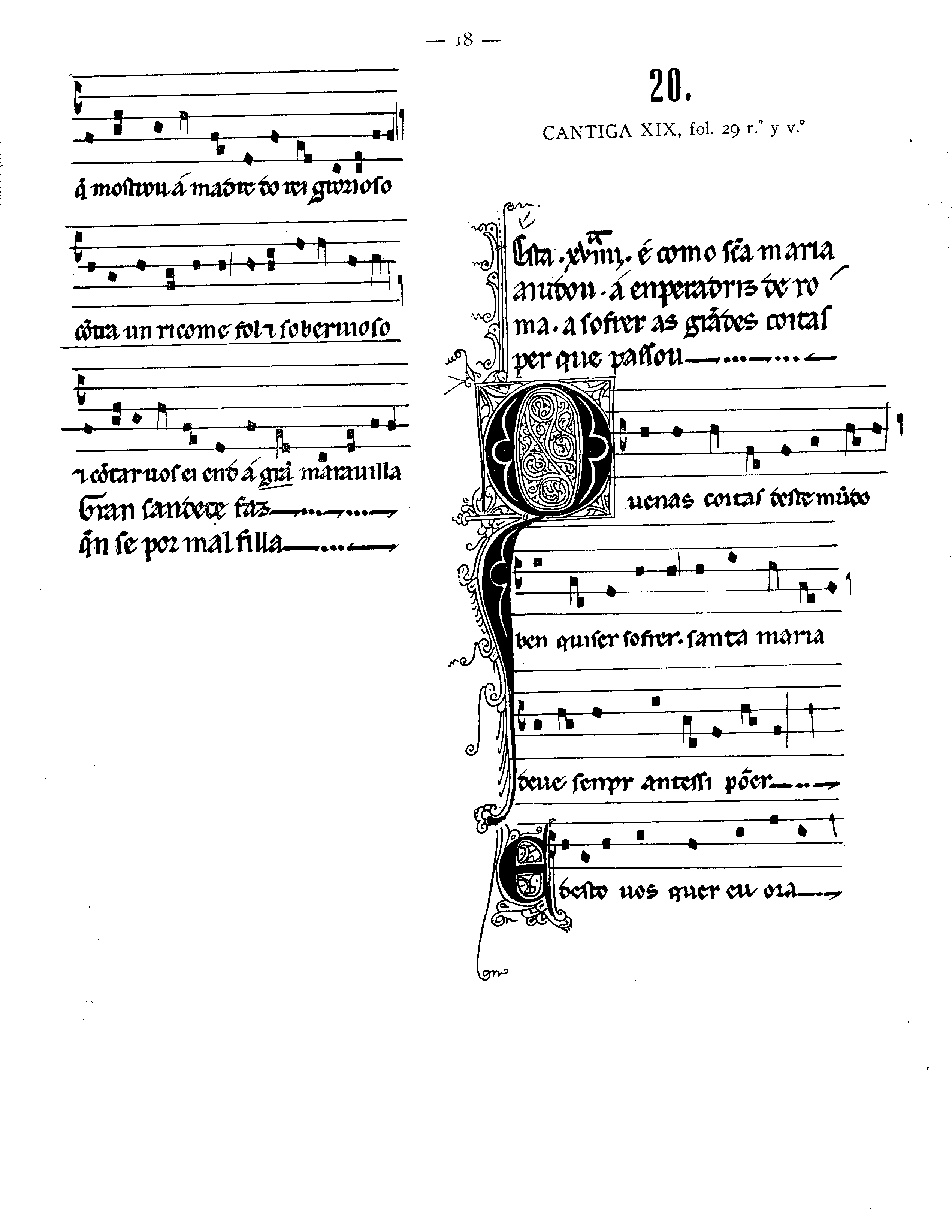
- 13th century CE, Alfonso X of Castile, Cantigas de Santa Maria, To codex, cantiga 5 (facsimile):
- Eſta ·xviiii· é como ſṫa maria aiudou · á emperadriz de roma · a ſofrer as grãdes coitaſ per que paſſou.
- This 19th is how Holy Mary helped the empress of Rome suffer the great pains she underwent.
- Eſta ·xviiii· é como ſṫa maria aiudou · á emperadriz de roma · a ſofrer as grãdes coitaſ per que paſſou.
Old Irish
Pronunciation
- IPA(key): [dʲe]
Preposition
de
- Alternative form of di (“of, from”)
- c. 845, St Gall Glosses on Priscian, published in Thesaurus Palaeohibernicus (reprinted 1975, Dublin Institute for Advanced Studies), edited and with translations by Whitley Stokes and John Strachan, vol. II, pp. 49–224, Sg. 26b7
- De dliguth trá inna n-il-toimdden sin, is de gaibthi “igitur”; quasi dixisset “Ní fail ní nád taí mo dligeth-sa fair i ndegaid na comroircnech.”
- Of the law then, of those many opinions, it is thereof that he recites “igitur”; as if he had said, “There is nothing which my law does not touch upon after the erroneous ones.
- c. 845, St Gall Glosses on Priscian, published in Thesaurus Palaeohibernicus (reprinted 1975, Dublin Institute for Advanced Studies), edited and with translations by Whitley Stokes and John Strachan, vol. II, pp. 49–224, Sg. 26b7
Pronoun
de
- third-person singular masculine/neuter of di (“of, from”)
- c. 845, St Gall Glosses on Priscian, published in Thesaurus Palaeohibernicus (reprinted 1975, Dublin Institute for Advanced Studies), edited and with translations by Whitley Stokes and John Strachan, vol. II, pp. 49–224, Sg. 26b7
- De dliguth trá inna n-il-toimdden sin, is de gaibthi “igitur”; quasi dixisset “Ní fail ní nád taí mo dligeth-sa fair i ndegaid na comroircnech.”
- Of the law then, of those many opinions, it is thereof that he recites “igitur”; as if he had said, “There is nothing which my law does not touch upon after the erroneous ones.
- c. 845, St Gall Glosses on Priscian, published in Thesaurus Palaeohibernicus (reprinted 1975, Dublin Institute for Advanced Studies), edited and with translations by Whitley Stokes and John Strachan, vol. II, pp. 49–224, Sg. 26b7
- Used after the comparative degree of an adjective in the meaning of English “the” before a comparative
- lía de ― the more (literally, “more of it”)
- c. 800–825, Diarmait, Milan Glosses on the Psalms, published in Thesaurus Palaeohibernicus (reprinted 1987, Dublin Institute for Advanced Studies), edited and with translations by Whitley Stokes and John Strachan, vol. I, pp. 7–483, Ml. 23d23
- Cía thés hí loc bes ardu, ní ardu de; ní samlid són dúnni, air ⟨im⟩mi ardu-ni de tri dul isna lucu arda.
- Though he may go into a higher place, he is not the higher; this is not the case for us, for we are the higher through going into the high places.
- (literally, “Though he may go into a place that is higher, he is not higher of it; this is not thus for us, for we are higher of it through going into the high places.”)
Pennsylvania German
Pronunciation
- IPA(key): /də/
Declension
| Pennsylvania German definite articles | ||||
|---|---|---|---|---|
| Masculine | Feminine | Neuter | Plural | |
| Nominative | der | die | es | die |
| Dative | dem or em | der | dem or em | de |
| Accusative | der or den | die | es | die |
Declension
| singular | plural | ||||||||
|---|---|---|---|---|---|---|---|---|---|
| 1st person | 2nd person familiar |
2nd person polite/formal |
3rd person | 1st person | 2nd person | 3rd person | |||
| m | f | n | |||||||
| nominative | ich | du de1 |
dihr der1 Sie |
er | sie se1 |
es | mir mer1 |
dihr der1 |
sie |
| dative | mir mer1 |
dir der1 |
eich Ihne Ne1 |
ihm em1 |
ihre re1 |
ihm em1 |
uns | eich | ihne ne1 |
| accusative | mich | dich | eich Sie |
ihn en1 |
sie se1 |
es | sie | ||
1unstressed
Phalura
Etymology
(This etymology is missing or incomplete. Please add to it, or discuss it at the Etymology scriptorium.)
Pronunciation
- IPA(key): /de/
Verb
de (auxiliary, Perso-Arabic spelling دےۡ)
- Past tense marker
Polish
Etymology
From the first letter of dupa.
Pronunciation
- IPA(key): /dɛ/
Audio (file) - Rhymes: -ɛ
- Syllabification: de
Further reading
- de in Polish dictionaries at PWN
Portuguese
Alternative forms
- d' (archaic, except for fixed terms)
Etymology
From Old Galician-Portuguese de (“of”), from Latin dē (“of”).
Pronunciation
- (Brazil) IPA(key): /d͡ʒi/
- (Southern Brazil) IPA(key): /de/
- (Portugal) IPA(key): /dɨ/
- (Nordestino) IPA(key): /di/
- (Caipira) IPA(key): /di/
- Hyphenation: de
Preposition
de
- of (in relation to)
- 2005, J. K. Rowling, Harry Potter e o Enigma do Príncipe [Harry Potter and the Half-Blood Prince] (Harry Potter; 6), Rio de Janeiro: Rocco, →ISBN, page 138:
- O protesto de Hermione foi abafado por uma risadinha alta.
- Hermione's objection was interrupted by a loud little laugh.
- os amigos dele
- his friends
- (literally, “the friends of him”)
- of (forms compounds; often untranslated)
- fones de ouvido
- headphones
- (literally, “phones of ear”)
- acampamento de verão
- summer camp
- of; about (on the subject of)
- Do que estavam falando?
- What were they talking about?
- of; -'s (belonging to)
- a casa de alguém
- someone's house
- -'s (made by)
- Você provou o bolo da minha mãe?
- Have you tried my mother’s cake?
- of (being a part of)
- capa do livro
- cover of the book
- of (introduces the month a given day is part of)
- Primeiro de janeiro.
- First of January.
- of (introduces the object of an agent noun)
- Hitler foi um exterminador de judeus.
- Hitler was an exterminator of Jews.
- of (introduces the name of a place following its hypernym)
- A vila de Iorque.
- The village of York.
- of; -en (made or consisting of)
- De que é feito?
- What is this made of?
- (literally, “Of what is made this?”)
- -long (having the duration of)
- um filme de duas horas
- a two hour-long movie
- of (indicates the composition of a given collective or quantitative noun)
- Milhares de pessoas vieram.
- Thousands of people came.
- of (characterised by; having the given quality)
- O templo não é mais um local de paz.
- The temple is no longer a place of peace.
- of (introduces the noun that applies a given adjective or past participle)
- Um balde cheio de água.
- A bucket full of water.
- from (born in or coming out of)
- De onde você é?
- Where are you from?
- by means of; by
- Eu sempre vou trabalhar de ônibus.
- I always go to work by bus.
- as (in the role of)
- Na festa, ele estava de bruxo.
- At the party, he was dressed as a wizard.
- in (wearing)
- Homens de Preto
- Men in Black
Usage notes
When followed by an article, a pronoun, a demonstrative pronoun or adjective, or an adverb denoting location, de is combined with the next word to give the following combined forms:
| De + article | Combined form |
|---|---|
| de + o | do |
| de + a | da |
| de + os | dos |
| de + as | das |
| de + um | dum |
| de + uma | duma |
| de + uns | duns |
| de + umas | dumas |
| De + pronoun | Combined form |
|---|---|
| de + ela | dela |
| de + elas | delas |
| de + ele | dele |
| de + eles | deles |
| De + dem. pronoun | Combined form |
|---|---|
| de + aquela | daquela |
| de + aquelas | daquelas |
| de + aquele | daquele |
| de + aqueles | daqueles |
| de + aquilo | daquilo |
| de + esse | desse |
| de + essa | dessa |
| de + esses | desses |
| de + essas | dessas |
| de + este | deste |
| de + esta | desta |
| de + estes | destes |
| de + estas | destas |
| de + isso | disso |
| de + isto | disto |
| de + outra | doutra |
| de + outras | doutras |
| de + outro | doutro |
| de + outros | doutros |
| De + adverb | Combined form |
|---|---|
| de + acolá | dacolá |
| de + algures | dalgures |
| de + ali | dali |
| de + além | dalém |
| de + antes | dantes |
| de + aqui | daqui |
| de + aquém | daquém |
| de + aí | daí |
| de + entre | dentre |
| de + estoutra | destoutra |
| de + estoutro | destoutro |
| de + onde | donde |
Quotations
For quotations using this term, see Citations:de.
Romanian
Pronunciation
- IPA(key): /de/
Audio (file) - Rhymes: -e
Conjunction
de
- (informal or literary) Synonym of dacă (“if”)
- (with the optative mood) if only
- (informal) to the effect that
- Synonyms: încât, (colloquial) că
- Mașina a demarat de i-au scârțâit cauciucurile.
- The car sped off [so fast] that its tyres screeched.
- Am așteptat de m-am plictisit.
- I waited [so much] that I got bored.
- Cum a jucat echipa de a pierdut așa de rău?
- How did the team play to lose so badly?
- Am dovleac de nu știu ce să fac cu el.
- I have [so much] squash that I don’t know what to do with it.
Usage notes
In the meaning of “if”, de is not typically directly followed by any word other than a verb, a pronoun (accusative or reflexive, but not nominative) or the word nu (“no”). The more common and style-neutral dacă is under no such restrictions.
As an informal synonym of încât, de can only be used in simple constructions and without any coordinative adverbs (atât, așa). Thus, it can be used in the sentence Vântul bate de ridică praful (“The wind blows [so hard] it raises dust”), but not if the first half were Vântul bate atât de tare. Conversely, încât and că would not be used in such simple sentences.
Preposition
de (+accusative)
- from
- Casa mea nu este departe de aici.
- My house is not far from here.
- of
- Beau o ceașcă de ceai.
- I’m drinking a cup of tea.
- Este profesor de matematică
- He’s a teacher of mathematics.
- for (intended for a certain destination)
- În magazin hainele de bărbați sunt în stânga, iar cele de femei în dreapta.
- In the shop, men’s clothes are on the left, while women’s are on the right.
- Ai cizme de lucru? ― Do you have work boots?
- Marks the point of action of a force of grip: by.
- Nu lua iepurele de urechi. ― Grab not the rabbit by the ears.
- Plăcile se prind numai de margini. ― Vinyls are held by the edges only.
- L-a mușcat câinele de mână. ― The dog bit him by the hand.
- Introduces the doer of a passive verb or participle: by.
- Asta e mâncare făcută de mine. ― This is food made by me.
- Avionul este acum controlat de autopilot.
- The plane is now controlled by the autopilot.
- Introduces the author of a work: by.
- Connects a cardinal numeral who is a multiple of 100 or whose tens are greater than 1 to the determinated noun.
- Suma este de două sute șaisprezece lei și patruzeci și patru de bani.
- The sum is 216 lei and 44 bani.
- Forms an adverbial numeral with ori or dăți.
- De câte ori a bătut ceasul? De șase ori.
- How many times did the pendulum clock strike? Six times.
- Precedes numbers and letters when they are themselves counted, like a Chinese classifier.
- Dacă ai un opt, o să îți trebuiască trei de zece ca să îți iasă media zece.
- If you have a grade of 8 (equivalent of a B), you’ll need three 10s (equivalent of an A) to still get an average grade of 10.
- „Nu fi” nu se scrie cu doi de i, ci cu unul.
- Nu fi (“don’t be”) isn’t written with two i’s, but with one.
- Connects most adverbs other than some basic ones to the determinated adjectives or adverbs.
- Motocicleta merge destul de repede. ― The motorbike is going pretty fast.
- Casa aceasta are o culoare nepotrivit de intensă.
- This house has an inappropriately bright colour.
- (only before numerals, designations of time, or the word atât) Synonym of decât (“than”).
- Război și pace are mai mult de o mie de pagini.
- War and Peace has more than a thousand pages.
- A trecut mai puțin de jumătate din vacanță.
- Less than half of summer break has passed.
- Nu se poate mai devreme de luna viitoare.
- It isn’t possible any earlier than next month.
- Poți chiar mai bine de atât.
- You can do even better than that.
- Marks the starting point of a state or recurring event: since, starting, as of.
- de acum încolo ― from now on
- Curentul e tăiat de ieri.
- The power is cut since yesterday.
- Noii angajați încep de săptămâna viitoare serviciul.
- The new employees are beginning work starting next week.
- Marks the duration of a state or recurring event persisting to the present: for, in
- Compania noastră este prezentă în România de șase ani.
- Our company has been present in Romania for six years.
- Nu te-am mai văzut de multă vreme.
- I haven’t seen you in a long time.
- (informal) Synonym of despre (“about”)
- Ce știe lumea de economie? ― What do people know about economy?
- Tocmai vorbeam de tine. ― We were just talking about you.
- (informal) Connects an often negative qualifier to a noun or pronoun: of a.
- Aici stă un nesuferit de moș. ― Here lives a jerk of an old man.
- Prostul de mine, am uitat. ― Foolish me, I forgot.
- (only of festive dates) on
- De Anul Nou sau de 1 Mai se petrece.
- On New Year or May Day one celebrates.
- Mi-am luat concediu de ziua mea de naștere.
- On my birthday I took a day off.
- Indicates the recipients of an equal distribution: per.
- Rația e de 2 litri de apă de persoană.
- The ration is 2 litres of water per person.
Usage notes
In the sense of “by”, de can be followed by către for clarification and to no change in meaning. This is typical of, but not restricted to, formal language.
In the sense of “about”, it can only be used after a verb, and not copulatively (“is about”) or after a noun (“a discussion about”). Despre, however, can be used in any of these situations.
Pronoun
de m or f or n (indeclinable)
Usage notes
De can replace any form of care in the nominative, accusative and dative case.
- Nominative: invitatul care a sosit — invitatul de a sosit (“The guest who arrived”)
- Accusative: casa pe care o văd — casa de o văd (“the house which I see”)
- Dative: unul căruia i-am plătit — unul de i-am plătit (“one to whom I paid”)
Genitive constructions cannot be expressed with de.
Replacement of accusative care preceded by a preposition is done with a resumption of the object: filmul la care ne-am uitat — filmul de ne-am uitat la el (“the film we watched”). Stylistically this is much less desirable.
References
- de in DEX online—Dicționare ale limbii române (Dictionaries of the Romanian language)
Romansch
Sardinian
Etymology
From Latin dē, from Proto-Italic *dē, ultimately from Proto-Indo-European *de.
Pronunciation
- IPA(key): /de/
Preposition
de (Logudorese, Campidanese, Nuorese)
- Used to indicate possession, after the thing owned and before the owner; of; ’s
- from
- by, of, ’s
- than
- Used in superlative forms; in, of
- about, on, concerning
- Expresses composition; of, made of, in or more often omitted
- (followed by an infinitive) to or omitted
- Used in some expressions in a partitive-like function, often without article.
References
- Rubattu, Antoninu (2006) Dizionario universale della lingua di Sardegna, 2nd edition, Sassari: Edes
- Wagner, Max Leopold (1960–1964), “de”, in Dizionario etimologico sardo, Heidelberg
Saterland Frisian
Pronunciation
- IPA(key): /də/
- Hyphenation: de
Scottish Gaelic
Alternative forms
Pronunciation
- IPA(key): /tʲe/
Preposition
de (+ dative, triggers lenition of consonants and Dh-prothesis of vowels, combined with the singular definite article dhen)
Usage notes
Inflection
| Personal inflection of de | |||||||||
|---|---|---|---|---|---|---|---|---|---|
| Number | Person | Simple | Emphatic | ||||||
| Singular | 1st | dhìom | dhìomsa | ||||||
| 2nd | dhìot | dhìotsa | |||||||
| 3rd m | dheth | dhethsan | |||||||
| 3rd f | dhith | dhithse | |||||||
| Plural | 1st | dhinn | dhinne | ||||||
| 2nd | dhibh | dhibhse | |||||||
| 3rd | dhiubh | dhiubhsan | |||||||
Derived terms
- bhàrr (“down from, from off”)
Serbo-Croatian
Etymology
From Proto-Slavic *kъdě, *kъde, from Proto-Indo-European *kʷu-dʰe.
Synonyms
Southern Ndebele
Etymology
From Proto-Bantu *-dàì.
Inflection
This entry needs an inflection-table template.
Spanish
Pronunciation
- IPA(key): (after a pause, 'l', 'm', 'n' and 'ñ') /de/ [d̪e]
- Syllabification: de
- IPA(key): (elsewhere) /de/ [ð̞e̞]
- Rhymes: -e
- Homophone: dé
Etymology 2

Preposition
de
- of; 's; used after the thing owned and before the owner
- Constitución española de 1812
- Spanish constitution of 1812
- la cola del perro
- the dog’s tail
- from (with the source or provenance of or at)
- Soy de España.
- I’m from Spain.
- agua de manantial ― springwater
- of (expressing composition, substance)
- una mesa de madera ― a wooden table
- about (concerning; with regard to)
- of, from (indicating cause)
- Murió de hambre.
- He died of hunger.
- of (indicates a quality or characteristic)
- un hombre de fe
- a man of faith
- from (with the origin, starting point or initial reference of or at)
- Synonym: desde
- el vuelo de Miami a Chicago
- the flight from Miami to Chicago
- of (indicates the subject or cause of the adjective)
- harto de ― sick of; tired of
- from (with the separation, exclusion or differentiation of)
- Nos protege del frío.
- It protects us from the cold.
- than (in certain phrases)
- más de ― more than
- menos de ― less than, fewer than
- used to construct compound nouns (with attributive nouns)
- campamento de verano
- summer camp
- (followed by the infinitive) indicates a conditional desire
- De haberlo sabido, no lo habría dicho.
- If I had known, I wouldn't have said it.
- indicates a time of day or period of someone's life
- de día ― during the daytime
- de niño ― as a child; during childhood
- (after a noun and before a verb) indicates the purpose of an object
- Synonym: para
- goma de mascar ― chewing gum
- caña de pescar ― fishing rod
Related terms
Further reading
- “de”, in Diccionario de la lengua española, Vigésima tercera edición, Real Academia Española, 2014
Sranan Tongo
Pronunciation
- IPA(key): /de/
Swedish
Etymology 1
From Old Norse þeir, from Proto-Germanic *þai (with noun ending -r).
Pronunciation
Pronoun
de (third-person plural nominative, dative and accusative dem, genitive deras, reflexive sig)
Usage notes
In most dialects, de (“they”) and dem (“them”) are no longer distinguished in speech. They are regularly mixed up in writing by native speakers, due to lack of grammatical intuition. The article de is often mixed up with dem as well.
Declension
| Number | Person | Type | Nominative | Oblique | Possessive | ||
|---|---|---|---|---|---|---|---|
| common | neuter | plural | |||||
| singular | first | — | jag | mig, mej3 | min | mitt | mina |
| second | — | du | dig, dej3 | din | ditt | dina | |
| third | masculine (person) | han | honom, han2, en5 | hans | |||
| feminine (person) | hon | henne, na5 | hennes | ||||
| gender-neutral (person)1 | hen | hen, henom7 | hens | ||||
| common (noun) | den | den | dess | ||||
| neuter (noun) | det | det | dess | ||||
| indefinite | man or en4 | en | ens | ||||
| reflexive | — | sig, sej3 | sin | sitt | sina | ||
| plural | first | — | vi | oss | vår, våran2 | vårt, vårat2 | våra |
| second | — | ni | er | er, eran2, ers6 | ert, erat2 | era | |
| archaic | I | eder | eder, eders6 | edert | edra | ||
| third | — | de, dom3 | dem, dom3 | deras | |||
| reflexive | — | sig, sej3 | sin | sitt | sina | ||
Article
de
- the, a definite article used in the beginning of noun phrases containing attributive adjectives and nouns in the plural. This article is used together with the definite suffix of the noun to indicate the definiteness of the noun phrase.
- de gröna bilarna ― the green cars
Usage notes
The same type of noun phrases with singular nouns instead use den (common gender) or det (neuter) for this function. Some definite noun phrases with attributive adjectives may skip these preceding articles. This is the case especially for many lexicalized noun phrases and also for many noun phrases working as proper names of organisations, geographical places, TV shows, events and similar.
- Brittiska öarna
- The British Isles
While the personal pronoun de has an object form and a genitive form, the definite article de is unaffected by the syntactic role of the noun phrase.
Related terms
Etymology 2
From the common pronunciation of this word.
References
Tabaru
Pronunciation
- IPA(key): [de]
Conjunction
de
References
- Edward A. Kotynski (1988), “Tabaru phonology and morphology”, in Work Papers of the Summer Institute of Linguistics, University of North Dakota Session, volume 32, Summer Institute of Linguistics
Tagalog
Pronunciation
- IPA(key): /de/, [dɛ]
See also
Noun
de (Baybayin spelling ᜇᜒ)
- (historical) the name of the Latin-script letter D, in the Abecedario.
Further reading
- Panganiban, José Villa (1973) Diksyunaryo-Tesauro Pilipino-Ingles, Quezon City: Manlapaz Publishing Co., page 360
Tarantino
Tok Pisin
Turkish
Alternative forms
Pronunciation
- IPA(key): /de/
Etymology 1
From Ottoman Turkish ده (da, de, “conj. also, and, moreover, again”)[1], from Proto-Turkic *tākı (“conj. and”)[2][3].
Conjunction
de
- as well, too, also
- Özer de sorunun yanıtını biliyor. ― Özer also knows the answer of the question.
- Berker de bizimle geliyor. ― Berker is coming with us as well.
- Utku da dondurma yemeyi sever. ― Utku likes eating ice cream, too.
- however
- Herkes iddia ediyor ki boyum uzamış da ben fark etmiyorum. ― Everyone claims that I've gotten taller however I don't really notice it.
Usage notes
- Complies with vowel harmony; takes the form da with vowels "a, ı, o, u" and de with vowels "e, i, ö, ü."
See also
References
- Redhouse, James W. (1890), “ده”, in A Turkish and English Lexicon, Constantinople: A. H. Boyajian, page 929
- Starostin, Sergei; Dybo, Anna; Mudrak, Oleg (2003), “*d(i)akɨ”, in Etymological dictionary of the Altaic languages (Handbuch der Orientalistik; VIII.8), Leiden, New York, Köln: E.J. Brill
- Nişanyan, Sevan (2002–), “de”, in Nişanyan Sözlük
Further reading
- "Bağlaç Olan da, de’nin Yazılışı" - at TDK Sözlük
Welsh
Pronunciation
- IPA(key): /deː/
- Rhymes: -eː
Etymology 1
Contraction of older deau (“right; south”), from Proto-Celtic *dexswos (“right”). Cognate with Cornish dyhow, Breton dehou, Irish deas, Scottish Gaelic deas, Manx jiass.
The sense "south" comes from the fact that the south is on the right-hand side of a person facing east.[1] Compare the relationship between cledd (“left”) and gogledd (“north”).
Adjective
Derived terms
- Môr y De (“the South Sea”)
- Pegwn y De (“the South Pole”)
Usage notes
- The noun has masculine gender when used with the sense of "south" and feminine gender when used with the sense "right".
Mutation
| Welsh mutation | |||
|---|---|---|---|
| radical | soft | nasal | aspirate |
| de | dde | ne | unchanged |
| Note: Some of these forms may be hypothetical. Not every possible mutated form of every word actually occurs. | |||
Derived terms
- de-ddwyrain (“south-east”)
- de-orllewin (“south-west”)
See also
- (compass points)
| gogledd-orllewin | gogledd | gogledd-ddwyrain |
| gorllewin |  |
dwyrain |
| de-orllewin | de | de-ddwyrain |
Etymology 2
See the etymology of the corresponding lemma form.
West Frisian
Usage notes
After one-syllable prepositions ending in a consonant, the variant 'e is used.
Further reading
- “de”, in Wurdboek fan de Fryske taal (in Dutch), 2011
West Makian
Pronunciation
- IPA(key): /d̪e/
See also
| independent | possessive prefix | |
|---|---|---|
| 1st person singular | de | ti |
| 2nd person singular | ni | ni |
| 3rd person singular | me | mVan., dVinan. |
| 1st person plural inclusive | ene | nV |
| 1st person plural exclusive | imi | mi |
| 2nd person plural | ini | fi |
| 3rd person plural | eme | di |
- V indicates the expected assimilated vowel of the following noun, following standard West Makian vowel harmony.
Xhosa
Etymology
From Proto-Bantu *-dàì.
Inflection
| Adjective concord, tone L | ||||
|---|---|---|---|---|
| Modifier | Copulative | |||
| positive | negative | positive | negative | |
| 1st singular | endimde | endingemde | ndimde | andimde |
| 2nd singular | omde | ongemde | umde | awumde |
| 1st plural | esibade | esingebade | sibade | asibade |
| 2nd plural | enibade | eningebade | nibade | anibade |
| Class 1 | omde | ongemde | mde | akamde |
| Class 2 | abade | abangebade | bade | ababade |
| Class 3 | omde | ongemde | mde | awumde |
| Class 4 | emide | engemide | mide | ayimide |
| Class 5 | elide | elingelide | lide | alilide |
| Class 6 | amade | angemade | made | awamade |
| Class 7 | eside | esingeside | side | asiside |
| Class 8 | ezinde | ezingezinde | zinde | azizinde |
| Class 9 | ende | engende | inde | ayiyinde |
| Class 10 | ezinde | ezingezinde | zinde | azizinde |
| Class 11 | olude | olungelude | lude | alulude |
| Class 14 | obude | obungebude | bude | abubude |
| Class 15 | okude | okungekude | kude | akukude |
| Class 17 | okude | okungekude | kude | akukude |
Ye'kwana
Pronunciation
- IPA(key): [de]
Particle
de
- expresses frustration
References
- Cáceres, Natalia (2011), “de”, in Grammaire Fonctionnelle-Typologique du Ye’kwana, Lyon
Yoruba
Alternative forms
- دعِ
Etymology 1
Pronunciation
- IPA(key): /dè/
Verb
dè
Usage notes
- de when coming before a direct object
Derived terms
- dèmọ́
- dèmọ́lẹ̀
- ìdè
Etymology 2
Pronunciation
- IPA(key): /dè/
Verb
dè
Usage notes
- Usually used with the word ipò (“position”)
- de when coming before a direct object
Pronunciation
- IPA(key): /dè/
Usage notes
- de when coming before a direct object noun
- Used as a verb-second element
Etymology 4
Pronunciation
- IPA(key): /dé/
Verb
dé
- (intransitive, copulative) to arrive
- A ti dé ― We have arrived
- (transitive) to attain, to reach a particular point
Pronunciation
- IPA(key): /dé/
Zande
Zealandic
Etymology
An unstressed variety of Middle Dutch die.
Zhuang
Etymology
(This etymology is missing or incomplete. Please add to it, or discuss it at the Etymology scriptorium. Particularly: “Proto-Zhuang-Tai *te.A?”)
Pronunciation
- (Standard Zhuang) IPA(key): /te˨˦/
- Tone numbers: de1
- Hyphenation: de
Zulu
Etymology
From Proto-Bantu *-dàì. The expected reflex would be -le, however it was changed due to analogy with its class 8, 9, and 10 forms (zinde, inde, zinde).
Inflection
| Adjective concord, tone L | ||||
|---|---|---|---|---|
| Modifier | Copulative | |||
| positive | negative | positive | negative | |
| 1st singular | engimude | engingemude | ngimude | angimude |
| 2nd singular | omude | ongemude | umude | awumude |
| 1st plural | esibade | esingebade | sibade | asibade |
| 2nd plural | enibade | eningebade | nibade | anibade |
| Class 1 | omude | ongemude | mude | akamude |
| Class 2 | abade | abangebade | bade | ababade |
| Class 3 | omude | ongemude | mude | awumude |
| Class 4 | emide | engemide | mide | ayimide |
| Class 5 | elide | elingelide | lide | alilide |
| Class 6 | amade | angemade | made | awamade |
| Class 7 | eside | esingeside | side | asiside |
| Class 8 | ezinde | ezingezinde | zinde | azizinde |
| Class 9 | ende | engende, engeyinde | inde, yinde | ayiyinde |
| Class 10 | ezinde | ezingezinde | zinde | azizinde |
| Class 11 | olude | olungelude | lude | alulude |
| Class 14 | obude | obungebude | bude | abubude |
| Class 15 | okude | okungekude | kude | akukude |
| Class 17 | okude | okungekude | kude | akukude |
Inflection
This verb needs an inflection-table template.
References
- C. M. Doke; B. W. Vilakazi (1972), “-dé”, in Zulu-English Dictionary, →ISBN: “-dé”
- C. M. Doke; B. W. Vilakazi (1972), “-de”, in Zulu-English Dictionary, →ISBN: “-de”