Árabe omani
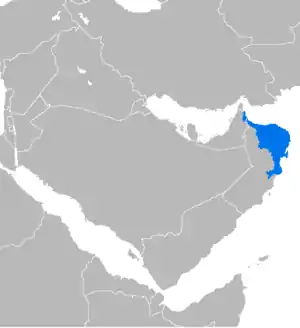
O árabe omanense, árabe omani ou ainda árabe omani hadari, é uma variante de árabe falado nas montanhas Hajar de Omã e em algumas regiões costeiras vizinhas.[1][2]
| Árabe omani | ||
|---|---|---|
| Falado(a) em: |  Omã Omã | |
| Região: | principalmente nas montanhas Hajar | |
| Total de falantes: | 720 mil no Omã (1996) | |
| Família: | Semítica Ocidental Central Centro-meridional Árabe Árabe peninsular Árabe omani | |
| Escrita: | Alfabeto árabe | |
| Códigos de língua | ||
| ISO 639-1: | -- | |
| ISO 639-2: | acx | |
| ISO 639-3: | acx
| |
| ||
Pertencente ao ramo do árabe peninsular, é o dialeto árabe mais oriental. Usado para comunicações diárias, não possui status oficial, este reservado ao árabe moderno padrão para fins oficiais, educacionais, comerciais e midiáticos.
Foi falado anteriormente por colonos no Quênia e na Tanzânia, mas hoje em dia continua sendo falado principalmente na ilha de Zanzibar.
A variante omanense pode ser dividida em outros dois dialetos principais: o árabe dofari e o árabe shihhi.[3][4]
Referências
- «How to Reach your Audience with the Right Dialect of Arabic». Asian Absolute (em inglês). 19 de janeiro de 2016. Consultado em 22 de junho de 2020
- «Arabic Language: Tracing its Roots, Development and Varied Dialects». Day Translations (em inglês). 16 de outubro de 2015. Consultado em 22 de junho de 2020
- Omani Arabic at Ethnologue (18th ed., 2015)
- Hammarström, Harald; Forkel, Robert; Haspelmath, Martin, eds. (2017). "Omani Arabic". Glottolog 3.0. Jena, Germany: Max Planck Institute for the Science of Human History.
This article is issued from Wikipedia. The text is licensed under Creative Commons - Attribution - Sharealike. Additional terms may apply for the media files.